


Product information
Do I receive a discount if I pick up my wines?
You can indicate with your order if you want to pick up your wines. If you choose this, you will see that in almost all cases* a 10% discount is automatically applied to your order. An additional advantage is that where possible, we will also deliver the products in the original packaging**
* Exceptions are articles that are already on sale and some scarce/exclusive wines
** If present and if ordered in packaging unit
How can I choose a wine that fits my flavor preference out of the huge assortment?
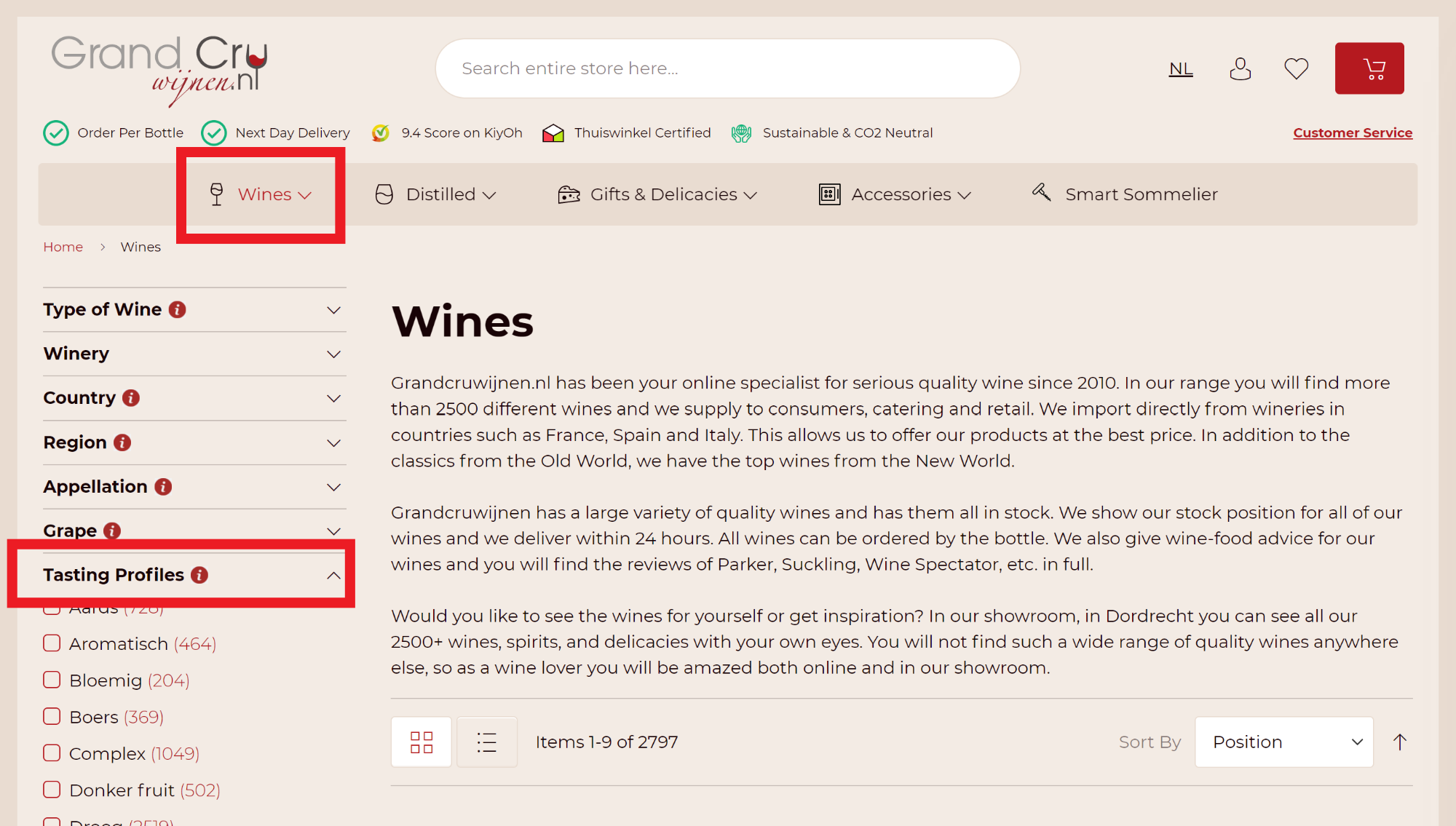
We have categorised our wines in so-called tasting profiles; see it as a DNA profile of the wine in which we classify the wine in elements such as flowery, fruity, wood-aged, tannines, and more — a total of 27 elements with which we filter the DNA profile of a wine. You can make a choice of these tasting profiles based on your personal taste preferences. After that, you can specify your choice further, for example with the suggestions in terms of price range or country of origin, region or grape.
Our suggestion is to first start with a wine sort (red, white, rosé, etc.) and optionally also add a country or region. After that, you can make a choice under the filter Tasting Profiles and the elements below, based on your flavor preference. With each additional selection, your overview will get refined further.
DNA / TASTE PROFILES
Floral
Rustic
Complex
Dark fruit
Dry
Fresh
Fruity
Green & grassy
Wood-aged
Powerful
Spicy
Light
Slightly sweet
Mineral
Rich
Round
Red fruit
Flexible
Stone fruit
Tight
Tannins
Tropical fruit
Full
White fruit
Sweet
How can we be sure we are not buying fake bottles?
In recent years there have been multiple "fakes" on the market of the established top houses from France, Italy, and Spain, among others. There is much more Petrus, Tignanello, Ornellaia, and Vega Sicilia on the market than has ever been made, to name just a few. Until a few years ago, the fake bottles were often around the high Super Tuscans and the top from Bordeaux and Bourgogne. However, in recent years, it has also frequently been seen with the Napa wines from the USA, the well-known Ribera del Duero, and Rioja houses, and the Brunello's, especially from 2015 and 2016 (very high ratings).
Grandcruwijnen only buys directly from the wineries or the official importers. Be very wary of offers "too good to be true" you run the risk of having a fake bottle with different content. Sometimes this is almost impossible to check and to distinguish from genuine, and the bottles are identical. The high-end wineries often have seals, holograms, etc., with which you can check the wine for authenticity on the site of the relevant winery. If this is possible, we will also mention this with the wine.
And even if the top offer is a real bottle, you never know what journey a bottle has been through. Wines can sometimes be a year in motion and eventually arrive at you from warm trucks, shipping containers, and unconditioned wineries. We know extreme examples of containers with the well-known champagne houses that are sometimes shipped from port to port for a year and are eventually sold well below the cost to get rid of them, and then you see a great offer, but in the end, the content is very doubtful. Our motto is "Buy your wines from a reliable wine merchant" and be very careful of those great offers from sometimes very well-known consumer wine platforms whose journey the wines have made cannot be traced.
How long can a wine or sherry be opened for?
There is not one answer to how long a wine can remain open. An opened bottle of wine comes into contact with oxygen and this oxidizes the wine. The result: a vinegar-like smell and taste. And the more wine is out of the bottle, the faster this process goes because relatively more oxygen is added. Therefore - regardless of the type - always put an opened bottle in the refrigerator. By cooling the wine, you slow down the oxidation process and so it "spoils" less quickly.
But how long can you keep an opened bottle of wine? Or even better, how long is the wine still nice to drink because the downside is that wine with wart oxygen can also improve again, especially if the wine is still young, has a lot of acidity or a lot of sweetness and for sherry (which in fact is a oxidized wine), other rules apply. As a rule, you can keep an opened bottle of wine for two to three days. But there are differences between red, white and rosé wines.
It is best to drink an open bottle of red wine within 2 days. If it was a wine with a lot of tannin, from a good year and / or from an aristocratic family from Burgundy, Bordeaux, Barolo or Barbaresco, 3-4 days is certainly possible and you can often see that the opened bottle is correct a day later. taste better.
You can often leave white and rosé a little longer (of course also in the fridge), but here too, 3 days is the maximum
Sparkling wines are trickier. After opening, the carbon dioxide (and the bubbles) will quickly disappear. Keep this wine for a maximum of one day
Sweet white wines, on the other hand, are more resistant to aging. The taste can change slightly, but about five days will work. Fortified wines such as Port, Sherry, Madeira keep their taste and aroma for at least a month after opening.
Port wines, especially the longer ones, can also be open for a number of weeks. Even then, of course, in the fridge. The sweetness and the fact that they have already undergone a certain oxidation makes this possible. For young port wines the same applies as for red / white wines and it is possible to open a number of days, but vacuuming is certainly possible for longer.
Sherry wines and certainly those that have matured under the flor for a long time have therefore undergone a very long time of biological aging under flor. They have already been exposed to quite a bit of oxygen during that process and ensures that it remains very stable (but also keep it in the refrigerator). We also checked this with Eduardo Ojeda, the famous winemaker of the top sherry house Equipo Navazos and indicated that he sometimes has his sherry wines open for months - also for visitors to taste. Logically, the wine becomes more and more in color and evolves, but retains its character. So yes in this case it does change but just because the sherries are already oxidative it doesn't mean they just become. In contrast, after a few days they seriously oxidize (red just a little earlier than white) and thus do not taste good
How to best store wine
So if you want to keep an opened bottle, the best way is to put it in the fridge. The cold of the refrigerator slows down the oxidation process. So put the wine to be stored in the fridge anyway. In addition, there are methods that slow down the aging process. By preventing the oxygen from coming into contact with the wine.
First of all, the best-known method: removing all air in the bottle by vacuuming the bottle. This is quickly and easily possible with a special cork and pump. Place the vacumm and then put it in the refrigerator.
Another method is to buy a Coravin. This means you don't have to open the bottle. With a needle you poke through the cork and take a glass of wine from the bottle. The space in the bottle is immediately filled with Argon gas. This fills up the empty space in the bottle so that no oxygen can enter.
Is your bottle corked?
Wine is a natural product that 'lives' and it is, therefore, possible that the quality deviates at any time. We will do our utmost to find a good solution, so please contact us immediately. The problem with cork or TCA is that the cause does not always have to come from the bottle. The TCA can also float around in your cellar or storage cupboard and can come from a lesser cork. The bacteria can penetrate through the wine while it is stored, so it can also be caused by an existing bottle (s). If you have cork regularly, you should empty your cellar and disinfect it properly, because the bacteria circulate in the air. Also, regularly changing the filter in a wine storage/fridge should not be overlooked.
We always try to solve this the best way we can, and if the wine has been purchased recently, the likelihoods are that the purchased wine is not good. However, with purchases made a long time ago, this is not possible. We always try to solve this, but we can not give a guarantee. With the more expensive bottles, it often means that you have to send the bottle to us. We can measure the TCA, and if in doubt, we send it to the winery, where we have it analyzed by them (by the way, we do this in all cases if the complaint is somewhat broader, such as; "The wine is not good" or "the wine is oxidized"). The goal is to drop by or send the wine, and if it is confirmed by us and/or the winery, we will reimburse the bottle and the shipping costs. As you can understand, it is difficult to arrange what to do with complaints where the product is no longer present.
What is Cork
Wine may have an off-flavor caused by contamination by a fungus or bacteria that forms 2,4,6-trichloroanisole (TCA), which is referred to as "Cork". The contaminated wine might have the smell of a musty or damp cellar due to the TCA bacteria and therefore does not taste good. The TCA bacteria can penetrate through a bad cork from outside the bottle to the wine while it is stored. Estimates of the percentage of wine bottles with the stale cellar smell range from 1% to 15%.
Just because cork floats in the glass does not mean that the wine is contaminated, as is commonly believed. Usually, this is the result of a Cork that is too dry or a badly opened bottle. This does not affect the taste. A little mold on the top of the cork is nothing to worry about either.
The natural cork is often seen as the culprit for the problem of the bad taste in wine. But this is unjustified. It has led many winemakers to use more stoppers made from plastic, pressed cork, or even screw caps. What is often overlooked, is that the problems with wine can have other causes than the natural cork, such as; oxidation, sulfur dioxide, a reducing odor, volatile acidity, 2,4,6-TCA, and microbiological spoilage. Of all these problems, the consumer can say: this wine has TCA. It is, therefore, possible that bottles without natural cork still taste like TCA. It is somewhat due to the wrong method of cleaning in the wine bottling plant itself. It has been found that the chlorine solutions used to sterilize corks were often the culprit, but, since 1996, the use of chlorine solutions has been banned under the "Code of Practice". Alternatively, the use of hydrogen peroxide is allowed.
Since 1995, the cork industry has been taking both preventive and curative measures to suppress the co-production of 2,4,6-TCA. However, the use of plastic stoppers and screw caps has shown that TCA or cellar flavor can have several causes. Cleaning agents based on chlorine products, crop protection agents used in the treatment of cork trees, and cardboard packaging bleached with chlorine compounds are just a few examples of sources of chlorine that can give rise to 2,4,6-TCA.
Should bottles be stored lying or standing?
A lot has been written about this and fortunately recent scientific research has also been done because there are too many myths and there is a kind of general thinking that bottles should be lying around. Research shows that there is no appreciable difference in the shelf life of the wine between being horizontal and being vertical.
A horizontal bottle keeps the cork moist so that it does not dry out and shrink. At least that's the theory, but science says otherwise: The air gap in a wine bottle has nearly 100 percent humidity, so the cork will never dry out as long as there is wine in the bottle. From a scientific point of view, it is therefore a myth that a cork dries out in a vertical position.
In 2005, the Australian Wine Research Institute tested this and found that the orientation of the bottle makes little difference to the wine's shelf life.
"The cork will never dry out with almost 100% humidity in the headspace, so it is a myth that you need to store a bottle on its side."
Amorim's director of R&D, Dr. Miguel Cabral (2018 study).
There are even recent scientific studies that recommend storing bottles upright, especially if the wines are stored for a long time. The continuous moisture against the cork when stored in a horizontal position for a long time affects the cork more than the 100% humidity that already exists in the bottle and this is better for the cork in the long term. Red wine can damage the cork, which is not an inert substance. It has not been shown that direct contact between liquid and cork has a (more) harmful effect on the aroma of the wine in the long term. It has been deemed possible but hardly researched.
Madera, champagne and Fino sherry are best kept upright. For long-term storage of wines with natural cork, vertical storage may well be the best storage condition.
A lot of advice on horizontal storage comes from the products of wine storage cabinets, wine counters, etc. that have an interest in this and many wine companies are talking to each other because this has been the case for centuries, but we believe more in the method Measuring is Knowing.
In summary, it does not matter from a sustainability perspective, and there is above all a reason that horizontal storage is more efficient and that most storage resources in particular are naturally based on horizontal storage. Especially in a shop setting, Vertical is better because the customer can then see the bottle better and it is therefore picked up less often, because precisely these types of movements are actually much worse.
...and besides all this, a constant temperature and no UV light are even more important for the longer storage of your wine. For that reason, Grandcruwijnen has fully air-conditioned its entire shop and warehouse and equipped it with LED lamps.
"STORING WINE ON ITS SIDE IS NONSENSE," SAYS SCIENTIST - 2018
During a discussion in Portugal last week, Cabral said that the headspace of a sealed bottle of wine was so moist that there was no need to place bottles on their side to keep the cork damp.
“The cork will never dry out with almost 100% humidity in the headspace, so it is a myth that you need to store a bottle on its side,” he said.
Continuing, he said that such humidity would ensure that the cork “won’t dry out if you store the bottle upright.”
He also said that creating moist ambient conditions during wine storage was unnecessary for bottled wine (although for barrel cellars it is important to reduce evaporation).
“The humidity of the environment around the bottle won’t have any influence, because the cork is influenced by the humidity inside the bottle,” he said, adding, “So the idea that you need to store wine in a damp cellar is another myth.”
He then stated, “The myths are falling down one by one now the cork industry has started doing studies.”
When asked later by the drinks business why wet corks in older wines are sometimes shrunken, he said that having the stopper permanently soaked by wine might actually accelerate the weakening of the cork’s cell structure.
In other words, not only is it unnecessary to keep the cork wet, it may actually be bad for the stopper.
Summing up, he said that such knowledge was nothing new in the scientific community.
“The AWRI published a paper on this back in 2005, but the problem is that people don’t read research papers, they just want the news,” he commented.
Finally, making his views clear, he stated, “The idea that storing a wine on its side to stop the cork drying out is bullsh•t.”
Previously, he recorded that 95-98% humidity in the headspace was high enough to ensure the passage of phenolics as well as taints from the cork into the wine – which would explain the presence of cork-derived TCA in a wine that had been stored upright.
As for factors that accelerate the evolution of wine in the bottle, aside from the failure of the seal – whatever the closure type – it is temperature that has the greatest affect, as higher temperatures speed up chemical reactions.
The study referenced by Cabral was published in 2005 by Skouroumounis et al from the Australian Wine Research Institute and it is entitled, ‘The impact of closure type and storage conditions on the composition, colour and flavour properties of a Riesling and a wooded Chardonnay wine during five years’ storage.
In the abstract it states “The bottle orientation during storage under the conditions of this study had little effect on the composition and sensory properties of the wines examined.”
Towards the end of the study it is noted that “temperature can have a direct effect on colour development through accelerating chemical reactions even without significant oxygen ingress.”
As for the condition of the corks used in the study, it records, “The two corks examined here differed substantially in their estimated wetness but appeared to perform similarly overall.”
The assessment of wine is from a different vintage. Why?
Not every vintage of a wine is evaluated by well-known wine judges such as Parker and James Suckling. In most cases, it is only done every few years. We state the assessment for you to read exactly which year the relevant evaluation is from. However, we always try to be as current as possible, and, where appropriate, we also show reviews of several vintages. We choose to do this because it gives a good indication about the wine. It is rarely the case that a highly valued wine suddenly receives a low rating. The wineries are often able to deliver consistent quality wines. The differences are often in the weather conditions of a particular vintage and are often minimal and subjective.
In other words, the reviews give a good indication and that's why we mention these, but nothing beats your own observation.
What are Parker Points?
Robert M. Parker, Jr. (Baltimore, Maryland, July 23, 1947) is an influential wine journalist from the United States of America. Parker studied history and law at the University of Maryland. He worked as a lawyer until 1984, before devoting himself entirely to wine. In 1978, Parker started The Wine Advocate because it was only a few reviews written by neutral people who did not connect to the wine industry. Parker made his name when he labeled the 1982 Bordeaux vintage, unlike most other wine journalists, "superb". In 2005, The Wine Advocate has 40,000 copies all over the world. The Wine Advocate and Robert Parker have become some of the most influential voices in the wine industry.
Points system:
Robert Parker tastes several thousand wines a year. These wines are classified on a 100-point scale. Wines with more than 90 points are the "A" wines.
*96-100, extraordinary wines
* 90-95, excellent wines
* 80-89, above-average, to very good wines
* 70-79, average wines
* 60-69, wines below average
* 50-59, unacceptable wines
Wines with several points below 50 are not rated by Robert Parker. Incidentally, Parker points out that there is no substitute for one's perception. Also, there is no better method of learning about wine than tasting the wine yourself.
We always show a fundamental assessment of a wine. It is important to mention that (often) not every vintage is assessed, so if the evaluation of a newer vintage is not (yet) available, we will show the most recent one. You can see in the assessment which vintage it is, but certainly, with quality wines, rarely, an evaluation between a wine changes very much. A wine with 94 points can get 91 points for a year, but we rarely see that this suddenly only gets 87 points with none of the professional wine reviewers. It is also true that this assessment is subjective, and in any case, our advice is that a review gives a direction and tells for sure whether a wine is good or bad. It can, however, say less about whether you like the wine or not, so your observation is what counts, and the reviews are particularly supportive in your choice of the right wine.
That is also why we have an exclusive subscription with the Wine Advocate, Suckling, Penin, and Winespectator, which entitles us to show the integral review text of several wines. This way, you as a customer can more easily find the perfect fit.
What are the different sizes of wine?
Most wine is in a standard 0.75-liter bottle, but that is not always the case. Especially Champagne is bottled in different sizes. Others (especially red wine) are also available in bottles with different volumes. We have made a list of the most important. Each format has its name, and the names of the biggest bottles are inspired by the Old Testament. These sizes are not standardized, so in case of doubt, always report the specifications because we also report the exact capacity in liters for a bottle of wine. If in doubt, please call or email us ([email protected]).
We also have a wide range of large sizes (from magnums to 18 liters). Click here for an actual overview.
Demi----------------- 37.5 cl - Standard half bottle
Fillette--------------- 37.5 cl - Small bottle, half bottle, the left bottle is typical of the Val de Loire
Bouteille---------------- 75 cl - Standard bottle
Magnum------------- 1,5 liter - Bottle with content of 2 bottles of 75 cl
Jeroboam--------------- 3 liter - Bottle with content of 4 bottles of 75 cl
Rehoboam--------------- 4.5 liters - Bottle with content of 6 bottles of 75 cl
Methuselah---------- 6 liters - Bottle with content of 8 bottles of 75 cl
Salmanazar---------- 9 liter - Bottle with content of 12 bottles of 75 cl
Balthazar--------------- 12 liter - Bottle with content of 16 bottles of 75 cl
Nabuchodonosor---- 15 liter - Bottle with content of 20 bottles of 75 cl
Melchior----------------- 18 liter - Bottle with content of 24 bottles of 75 cl
Jeroboam
The first sovereign ruler of the kingdom of Israel (930-910 BC). After Solomon's death, he was proclaimed king by the tribunes from the north, who had rebelled against Roboam. In addition to the pre-existing Hebrew schism that was political, he now added a religious dimension, as Dan chose and Bethel as a holy place.
Rehoboam
King of Judea (930 BC) Son of Solomon, who reigned as a tyrant and caused the division between the tribes of the North (together with Israel).
Methuselah
According to the Bible, Methuselah, a Jewish patriarch, lived to be 969 or 720 years old.
Salmanazar
Name of 5 Assyrian kings, of which Shalmanazar III was the most important.
Balthazar
Son of Nabonidus and regent of Babylon, killed by Cyrus in 539 BC. According to the Bible, the prophet Daniel is said to have foretold his death and the end of his kingdom by translating an inscription. The inscription was put on a wall by an invisible hand during a feast (Mane, Thekel, Phares)
Or also: One of the 3 kings. (next to Melchior and Caspar).
Nabucho Donosor (Nebuchadnezzar)
Feared king of Babylon (from 605 to 562 BC). He conquered Syria and Palestine in 604 and took Jerusalem several times (ts. 605 and 587), deporting the Jewish population (586-538). Under his rule, the Neo-Babylonian Empire was at its peak.
Melchior: One of the 3 Kings
It is confusing that there is a difference in name between still wines and bubbles, such as champagnes
What are Wine Spectator points?
The Wine Spectator magazine has been read by over 3 million people around the world. The digital publications, apps, and events extend this global reach to more than 6 million wine enthusiasts.
Wine Spectator's tasting staff consists of 15 professional tasters and tasting coordinators. They work together to review more than 16,000 wines each year; more than 400,000 reviews are currently available in the online database, and Grandcruwijnen has a subscription here in which we are entitled to show the reviews in full. Wine Spectator mainly focuses on the American and South American houses and the well-known Italian, Spanish and French houses.
The wines are judged in independent blind tastings, which is the guarantee that our reviews are fair, objective and that a wine's reputation/price will not affect its score. Each taster relates to specific wines and regions; their initials added to their ratings.
In general, we can see that the Wine Spectator often is a bit more critical than Parker and Suckling and consistently tastes everything blind. Wine Spectator does not engage in en-scoop tastings (such as assessing wines that are not released yet). Not every vintage will be rated because the levels of houses being assessed are so high that a rating of a previous vintage is a pretty good indication. For that reason, we also show the most recent assessment of a vintage. It is also possible that there is already a newer vintage that has not (yet) passed the Wine Spectator panel.
Wine Spectator's 100-Point Scale
What do the points mean at; James Suckling, Parker, Winespectator and Penin?
Most wine evaluators use a model in which the wines are classified on a 100-point scale. Wines with more than 90 points are the A wines.
* 96-100, extraordinary wines
* 90-95, excellent wines
* 80-89, above-average to very good wines
* 70-79, average wines
* 60-69, wines below average
* 50-59, unacceptable wines
The reviews give a good indication, but you should not rely on this only, and the opinion of the Professionals is also a subjective opinion. There is no substitute for one's perception. Also, there is no better learning method about wine than tasting the wine yourself, and in the end, it is only your taste that counts. So if you like a low-rated wine, then so be it.
In principle, with wines that score between 80-100 points, you are dealing with a well-made wine, but in the end, you decide whether you like it.
It is important to mention that not every vintage of a wine is evaluated. If a vintage has not been reviewed, we show the most recent vintage because this gives a good indication of a reviewer's opinion of wine and winery. Especially since our range includes internationally known wineries, and we do not work with products that bottle the same wine under 15 labels, the ratings of an earlier vintage are also very indicative. You will see that there are minor differences between the vintages, but these are very minimal, and in the event of a drop (a bad harvest), we always skip this vintage.
Of course, you can always see in the assessment which vintage it is, but certainly, with quality wines, rarely, an evaluation between a wine changes very much. A bottle of wine with 94 points can suddenly have 87-points a year later, and a review is subjective and in any case. Our advice is that a review gives a direction, and tells whether a wine is well made or not, but says less about whether you like the wine or not. Your perception is what counts, and the reviews are particularly supportive of your choice of the right wine.
That is why we also have an exclusive subscription with the Wine Advocate, Suckling, Penin, and Winespectator, which entitles us to show the integral review text because that is what we consider more important for you as a customer than the number that the wine has received.
What is the meaning of the drinking window advice
We indicate the drinking window of a wine. The date from which you can best drink the wine and until when. This advice is based on input from experts such as Parker, Suckling, and the wine companies in their technical sheets. We also incorporate our own opinion into this, and all this leads to a drinking window.
It is important to mention that this is NOT a guarantee and only an indication or advice. It also assumes a good/ideal way of storage (no UV, no vibration, humidity, constant cool temperature). Even then, it is possible that a natural product, like wine, can reach its peak sooner. But sometimes can just as well be kept longer.
Which reviews are listed?
We will show the reviews of the Wine Advocate, James Suckling, Wine Spectator, Gamberro Rosso, and Peñin when available. By clicking on the icon/logo next to the wine, you will see the entire assessment of the wine. Most ratings are based on a system where the wines are classified on a 100-point scale. Wines with more than 90 points are the "A" wines.
* 96-100, extraordinary wines
* 90-95, excellent wines
* 80-89, above-average to very good wines
We would also like to point out that there is no substitute for your perception. There is also no better learning method about wine than tasting the wine yourself, and we would even like to say that the observations of the professionals are also subjective in the end.
De foto van de wijn wijkt af van de de wijn zoals wij ontvangen hebben. Hoe kan dat?
De informatie die wij melden op de website is maatgevend en de foto hoeft dat niet altijd te zijn alhoewel wij proberen zo actueel en goed als mogelijk de foto te tonen van een betreffende wijn. Redenen hiervoor zijn:
- en primeur wijnen - hier hebben wij de flessen nog niet van. Soms kan dit wel 1-2 jaar duren
- we ontvangen foto's van de producent maar de verpakking (label, wel/geen giftbox) blijkt toch anders te zijn
- nieuwe jaargangen
- wijn die in kisten zitten en we niet op voorhand al openmaken
Zodra wij de wijnen daadwerkelijk binnen hebben of een bestelling krijgen van een enkele fles uit een gesloten kist proberen we zo snel als mogelijk deze wijnen in onze eigen studio te fotograferen(stilstaand en 360 graden). Als een wijn in een geschenkendoos of kist zit dan vermelden wij dat altijd bij de specificatie en in de tekst dus deze is altijd leidend en niet de afbeelding.
Ik vind de wijn niet overeenkomen met de beschrijving op Grandcruwijnen
Het kan voorkomen dat de smaak van een wijn niet (helemaal) overeenkomt met de beschrijving oponze website of in een recensie. Grandcruwijnen staat bekend om zijn uitgebreide informatie en wij trachten de subjectieve waarnemingen zo objectief mogelijk weer te geven. Derhalve proeft ons team de wijnen maar tonen we ook integraal de (meest) recente beoordelingen van de internationale wijnpers welke gratis en integraal getoond worden bij een wijn. Er zijn verschillende redenen waarom er toch een verschil kan zijn in de beschrijving versus eigen waarneming. Hierover valt wat ons betreft niete te discuseren en eigen smaak is
-
Subjectiviteit: Smaak is zeer subjectief. Wat voor de ene persoon aantrekkelijk is, kan voor een ander totaal anders zijn. De beschrijvingen van wijnen zijn vaak gebaseerd op de ervaringen en smaakpercepties van individuen en kunnen daarom verschillen van wat jij persoonlijk proeft.
-
Omgevingsfactoren: De omgeving waarin je de wijn proeft, kan van invloed zijn op hoe je de smaak ervaart. Verschillende omgevingsfactoren, zoals temperatuur, belichting, het gebruikte glaswerk en zelfs de voedingsmiddelen die je eerder hebt gegeten, kunnen allemaal van invloed zijn op hoe je de wijn waarneemt.
-
Bewaarcondities: Als de wijn niet op de juiste manier is opgeslagen of als de fles beschadigd is geweest, kan dit de smaak van de wijn beïnvloeden. Licht, temperatuurvariaties en een verkeerde luchtvochtigheid kunnen de kwaliteit van de wijn aantasten.
-
Variatie tussen flessen: Wijnen kunnen van fles tot fles variëren, zelfs als ze van hetzelfde batchnummer zijn. Dit kan te maken hebben met kleine verschillen in de productie, opslag of botteling.
Over het algemeen is het belangrijk om te onthouden dat wijnproeven een subjectieve ervaring is en dat persoonlijke voorkeuren kunnen verschillen.
Dan is er nog een zeer belangrijk element en dat is wat er gebeurt als een wijn wat ouder wordt. Wat betreft de veroudering van wijn, verandert de smaak en structuur van wijn naarmate deze langer wordt bewaard. Niet alle wijnen zijn echter bedoeld om te rijpen; sommige zijn gemaakt om jong gedronken te worden, terwijl andere wijnen juist baat hebben bij rijping om hun volledige potentieel te bereiken.Tijdens het verouderingsproces kunnen chemische reacties in de wijn plaatsvinden die leiden tot veranderingen in de smaakprofielen. Tannines, zuren en alcohol in de wijn kunnen met elkaar in evenwicht komen, waardoor de wijn zachter wordt en complexere smaken ontwikkelt. Dit kan resulteren in aroma's van gedroogd fruit, leer, tabak of specerijen, afhankelijk van het type wijn.
Witte wijnen hebben doorgaans een korter verouderingspotentieel dan rode wijnen. Sommige rode wijnen, zoals bepaalde Bordeaux, Barolo, Brunello di Montalcino en topklasse rode Bourgognes, kunnen echter tientallen jaren verbeteren in kwaliteit en complexiteit als ze onder de juiste omstandigheden worden bewaard.
Het is belangrijk op te merken dat niet alle wijnen baat hebben bij veroudering en sommige wijnen hun piek al bereiken kort na botteling. Het drinken van een wijn op het juiste moment, binnen het optimale drinkvenster, kan de meest bevredigende ervaring bieden voor die specifieke fles. Met de tijd zal het profiel veranderen van een wijn. soms ten goede, soms ten nadele en soms verandert het profiel en blijft het een prachtwijn maar gaan andere tonen de bovenhand voeren. In dat geval zult u ook zien dat de omschrijving van de wijn zoals door ons wordt getoond maar zekerd ie van de wijn-cititici en zelfs de originele factsheets van het wijnbedrijf niet meer overeenkomst.
Er zijn ook verouderings-elementen die een wijn kan krijgen die door sommige als een verbetering wordt gezien terwijl andere dit juist zien als een verslechtering zien. Goede voorbeelden zijn dat rode wijnen met veroudering frisheid verliezen en juist meer gekookt fruit krijgen. Ook een bekende verandering is de (lichte) oxidatieve toon die oudere (rode en witte) wijnen kunnen krijgen. Sommige wijnen zijn hier super beroemd voor maar hier blijft gelden: You love it or You hate it en ook hier valt niet over te twisten en geloven wij dat het aller belangrijkste altijd eigen smaak (ontwikkeling) is en om die reden geven wij al sinds dag 1 van ons betaan de mogelijkheid om alles per fles aan te schaffen om zo goed proeven mogelijk te maken en niet gelijk verplicht te worden een doos/kist te moeten aanschaffen.
Is de afbeelding op de website altijd ook de fles zoals ik deze zal ontvangen
Wij doen ons uiterste best om zo accuraat als mogelijk de juiste flesafbeelding weer te geven en om die reden is Grandcruwijnen ook de enige die 360 graden maakt van de daadwerkelijke flessen, maar er zijn zeker situaties dat dit niet lukt dus er kunnen geen rechten worden ontleend aan de afbeelding die we tonen. Redenen kunnen zijn
- de fysieke flessen zijn nog niet in ons magazijn
- bij nieuwe wijnen of nieuwe labels zit er altijd een periode tussen de fysieke ontvangst en moment van maken van de nieuwe foto's
- het wijnbedrijf heeft label veranderd
- het wijnbedrijf heeft besloten om wijn niet meer in omdoos of geschenkendoos te verpakken maar kiest voor bijv een folie en geen omdoos
- en primeur bestellingen. We bieden wijnen al in voorkoop aan maar ontvangen deze pas later en dan pas wordt daadwerkelijk label vrijgegeven
- we hebben afbeeldingen ontvangen van wijnbedrijf en deze tonen maar blijken in de werkelijkheid toch net anders te zijn
- de wijnen hebben wij ontvangen in luxe verpakking of in kisten en deze houden wij gesloten voor geval klanten deze in verpakkingseenheid wilt ontvangen (OWC) en maken de kist niet open
In alle gevallen doen wij ons uiterste best om zodra de fysieke flessen in ons magazijn zijn of een kist moet worden aangebroken om dan zo snel als mogelijk actuele foto's te maken van het product en in 95% worden hier dan ook 360-graden foto's van gemaakt maar met ruim 3.000 verschillende wijnen en doorlopende veranderingen vergt dit doorlooptijd. In geval van twijfel en zeker wanneer een uitmonstering heel belangrijk voor u is, kunt u ons altijd mailen met verzoek even een actuele foto te sturen, zodat u zeker weet dat wat u bestelt de uitmonstering heeft zoals u zou verwachten. Stuur in dat geval een mail naar [email protected]
Kan ik de officiële factsheets van de wijnen inzien als deze er zijn?
De klanten die bij ons een Account hebben en toestemming hebben gegeven voor de nieuwsbrieven hebben een aantal extra voordelen die serieus de moeite waard zijn.
- U ontvangt automatisch in bijna alle gevallen korting in de vorm van kortingspunten.
- U kunt gratis de integrale review teksten inlezen van Parker, Suckling, Vinous, Wine spectator, Decanter, etc
- U heeft inzage in uw order-historie
- U heeft inzage (en kunt deze zelfs downloaden) in de officiële factsheets, presentaties, oogstrapporten, foto van de betreffende wijn/wijnhuis (indien voorhanden)
- Gerichte en exclusieve aanbiedingen of vooraankondigingen
M.a.w. het loont zeer om een Account met Nieuwsbrief consent te hebben bij Grandcruwijnen
Kan ik een beoordeling achterlaten over een wijn?
U kunt over een wijn een review achterlaten. Dit wordt door ons en onze klanten zeer gewaardeerd. Wij tonen zelf, daar waar beschikbaar, de meeste recente reviews van de wijn-ciritici zoals Parker, Suckling, Vinous en Wine Spectator maar natuurlijk is het zeer prettig als de ervaringen van onze klanten ook worden vermeld. Het is voor uzelf ook zeer prettig want u kunt dan altijd terugzien in de historie van uw aankopen wat u vond van de wijn (Nb - wilt u deze historie dan dient u wel een account aan te maken zodat alle deze informatie wordt bijgehouden).
Het achterlaten van een recensie of review is zeer eenvoudig. U klikt daarvoor op de bewuste wijn waarover u een beoordeling wilt achterlaten. In de detail-pagina van de wijn. Als u hier klikt op Recensies dan kunt u een recensie achterlaten over de wijn. U kunt de wijn een aantal sterren geven en een korte beschrijving geven. Voor het overige hoeft u niet uw naam te geven en wij vragen alleen uw email-adres omdat we in principe alleen maar reviews tonen van klanten die bij ons ook de wijn hebben gekocht. Vanzelfsprekend tonen wij dit email-adres niet conform ons privacy beleid en dient dit alleen maar ter controle bij plaatsing van de review zodat we geen fake-reviews krijgen.
Wij tonen in principe alle beoordeling over de wijnen maar er zijn enige spelregels:
- geen ongepast taalgebruik (o.a. schutting taal, beledigende woorden)
- factueel niet kloppende feedback/misbruik
- de klant dient bij ons de wijn te hebben aangeschaft
