

2021 Marchand-Tawse Mazis-Chambertin Grand Cru
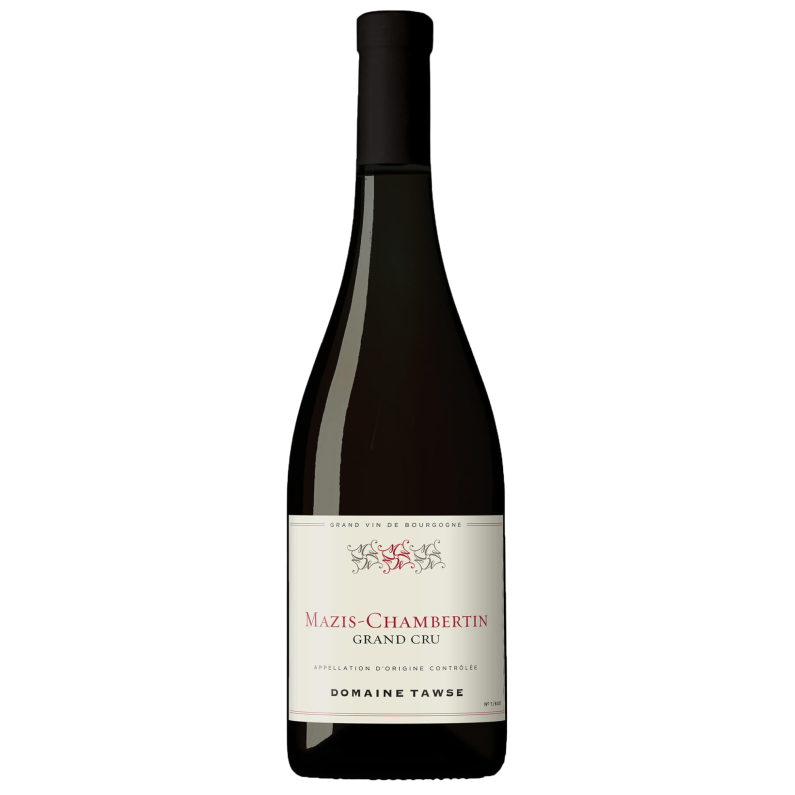
De specificaties zoals vermeld bij de wijn (o.a. wijnjaar) en in de titel zijn leidend en er kunnen geen rechten worden ontleend aan de afbeelding die wordt getoond. Lees meer in onze Frequenty asked questions
| Type of Wine | Red |
|---|---|
| Country | France |
| Region | |
| Appellation | |
| Winery | |
| Vintage | 2021 |
| Grape | |
| Content (Alc) | 0.75 ltr (14%) |
| Drink window | 2030 - 2055 |
Out of Stock
Currently unavailable
Notify me when this product is back in stock
Description
Pascal Marchand, Canadian by birth and from Quebec, became known as a 'flying winemaker' in Australia and Chile, but because of his passion for Bougogne and the advice of the legendary Henri Jayer, he came to France in 1983 to actually become a winemaker in his favorite region. . He was directly inspired by the young generation of pioneers who started using organic and biodynamic methods.
The Marchand-Tawse 2021 Mazis-Chambertin comes from vines with an age of 52 years. They work with 10% whole bunches. Four to seven days of cold maceration. Then pump over at the start of fermentation. As the vinfication progresses, gentle pressing with the feet and then with "pigeurs". The entire vinification takes 18 days. The wine matures for 18 months in 70% new wooden barrels. The wine is not clarified or filtered before being bottled.
The Mazis-Chambertin Grand Cru 2021 contains 10% whole bunches with 70% new oak. The palate is medium-bodied with fine tannins, good structure and symmetry, sharp acidity and softly building red fruit, leading to a complex and persistent aftertaste. Great potential, this is a fantastic Mazis.
FACT: In the Tab: Appendix you will find the official fact sheet of this wine. We will send it to you automatically when you order this wine
Specifications
| Block Bundle Options | No |
|---|---|
| Type of Wine | Red |
| Country | France |
| Region | Bourgogne |
| Appellation | Gevrey-Chambertin |
| Icons | Icon France |
| Winery | Marchand-Tawse |
| Grape | Pinot Noir |
| Biological certified | No |
| Natural wine | No |
| Vegan | No |
| Vintage | 2021 |
| Drinking as of | 2030 |
| Drinking till | 2055 |
| Alcohol % | 14 |
| Alcohol free/low | No |
| Content | 0.75 ltr |
| Oak aging | Yes |
| Sparkling | No |
| Dessert wine | No |
| Closure | Cork |
| Vinous rating | 97 |
| Tasting Profiles | Earthy, Rustic, Complex, Dry, Fruity, Aged on wood, Mineral, Red fruit, Flexible |
| Drink moments | Cadeau!, Lekker luxe, Met vrienden, Open haard, Romantisch |
Professional Reviews
Vinous
(95-97)
Drinking Window
2026 - 2048
From: Servants of the Seasons: Burgundy 2021 (Jan 2023)
The 2021 Mazis-Chambertin Grand Cru contains 10% whole bunches with 70% new oak. This is much more reduced than the Mazoyères so is difficult to read. The palate is medium-bodied with fine tannins, good structure and symmetry, a keen thread of acidity and gently building red fruit leading to a complex and persistent finish. Great potential, this is a superb Mazis.
- By Neal Martin on November 2022
Before broaching the wines, winemaker Mark Fincham, accompanied by Pascal Marchand, explains that there had been yet another very recent alteration in the name of the wines. In a region where name is critical to understanding what is in the bottle, I find this new change confusing after what I felt was finally a solution last year. They had no choice since authorities stipulated that the Domaine and Négociant wines would have to be made in separate wineries, which was logistically out of the question. So in 2021, the Domaine wines are listed as “Marchand-Tawse (Vignes de la Famille Tawse)” and négociant simply “Marchand Tawse”.
“We were affected by the frost,” Fincham tells me, “At the Domaine, we lost about 80% in the Côte de Beaune. Some examples: Volnay Fremiets 2 barrels in 2021 and 11 barrels in 2022; Savigny 1er Cru Les Vergelesses 4 barrels in 2021 compared to 15 barrels in 2022. One of the business drivers is our Bourgogne Chardonnay; we made zero. In the Côte de Nuits it was more nuanced, helped by later bud break. Here, we were between 30% to 50% down. In my view, it weakened the vines’ resistance, and we had more disease pressure, particularly mildew, after the very wet spring and early summer. There was a lot of disease pressure in the Côte de Nuits, especially in Morey-Saint-Denis. Estates like us, being organic, if you did not spray once a week, you could lose the crop. We started the picking on September 21 in the Côte de Beaune and the Côte de Nuits four days later, finishing on 28 September. In the end, we lost around 30-50% in the Côte de Nuits, but there are exceptions, though we lost 60% to 80% in the Côte de Beaune. I definitely lost another 10% here during sorting.”
Seeing this producer get due respect in recent years has been gratifying. They can kick the ball out of the park on occasion. That said, 2021 is a mixed bag that reflects the vagaries of the growing season, triumphs nestling alongside the odd expected disappointment. There are one or two cuvées where I feel the new oak impedes across the terroir expression – the vintage simply did not bestow sufficient fruit to support the wood. Other times, Marchand and Fincham produce some quite superb 2021s that I find difficult to resist imbibing.
Lorem ipsum dolor sit amet, consectetur adipiscing elit. Sed do eiusmod tempor incididunt ut labore et dolore magna aliqua...
Exclusive Content
Sign in to unlock professional wine reviews from world-renowned critics
Wijnhuis
Pascal Marchand, Canadian by birth and from Quebec, became known as a 'flying winemaker' in Australia and Chile, but because of his passion for Bougogne and the advice of the legendary Henri Jayer he came to France in 1983 to actually become a winemaker in his favorite region . He was directly inspired by the young generation of pioneers, who started using organic and biodynamic methods.
More information about Merchand-Tawse
The story of the Maison Marchand-Tawse in Burgundy begins with the extraordinary story of Pascal Marchand, the French-Canadian boy prodigy, who took over the reins of the Clos des Epeneaux in Pommard in 1985 at the age of 22. He became an overnight sensation, and is certainly one of the founders of modern Burgundy. But the Clos des Epeneaux is small. And for a young, talented and ambitious winemaker, 15 years was enough. He needed a new challenge. And he found one!
Merchand-Tawce's Approach
Pascal was approached by Jean-Charles Boisset, scion of the family that controls the third largest French wine group, who wanted to create a domain that would be the showcase for the family's other companies. So with the 1999 vintage, the Domaine de la Vougeraie was launched, giving Pascal the management of more than 90 hectares of Burgundy vineyards, from simple regional appellations to Grand Crus. It was the largest creation of a single estate in Burgundy since the end of World War II. And it quickly became a reference for modern Burgundian production. Pascal took the entire domain into organic farming, with a biodynamic approach. It was revolutionary. During the seven years he was there, Pascal also participated in the development of several other projects in the Boisset group outside Burgundy and abroad. At the same time, he worked as a consultant for wineries around the world, becoming one of the most famous "flying winemakers".
Marchand developed his own wine estate and established himself with his financial partner Moray Tawse as a micro-negociant under the name Marchand-Tawse. In addition, in 2011 this partnership acquired the former and important Domaine Maume, now labeled as Maume-Marchand-Tawse and since then positive reforms have been implemented. Despite the expansions, Marchand deliberately wants to keep it small-scale on the domain. His wines offer great drinking pleasure at a young age, but are vinified in such a way that they can ripen beautifully with confidence and appear to develop well. Each produced wine is approached individually in order to optimally show its own character and terroir origin. The use of wood is therefore highly differentiated and biodynamic methods are becoming increasingly noticeable.

Pascal Marchand, Canadian by birth and from Quebec, became known as a 'flying winemaker' in Australia and Chile, but because of his passion for Bougogne and the advice of the legendary Henri Jayer, he came to France in 1983 to actually become a winemaker in his favorite region. . He was directly inspired by the young generation of pioneers who started using organic and biodynamic methods.
The Marchand-Tawse 2021 Mazis-Chambertin comes from vines with an age of 52 years. They work with 10% whole bunches. Four to seven days of cold maceration. Then pump over at the start of fermentation. As the vinfication progresses, gentle pressing with the feet and then with "pigeurs". The entire vinification takes 18 days. The wine matures for 18 months in 70% new wooden barrels. The wine is not clarified or filtered before being bottled.
The Mazis-Chambertin Grand Cru 2021 contains 10% whole bunches with 70% new oak. The palate is medium-bodied with fine tannins, good structure and symmetry, sharp acidity and softly building red fruit, leading to a complex and persistent aftertaste. Great potential, this is a fantastic Mazis.
FACT: In the Tab: Appendix you will find the official fact sheet of this wine. We will send it to you automatically when you order this wine
| Block Bundle Options | No |
|---|---|
| Type of Wine | Red |
| Country | France |
| Region | Bourgogne |
| Appellation | Gevrey-Chambertin |
| Icons | Icon France |
| Winery | Marchand-Tawse |
| Grape | Pinot Noir |
| Biological certified | No |
| Natural wine | No |
| Vegan | No |
| Vintage | 2021 |
| Drinking as of | 2030 |
| Drinking till | 2055 |
| Alcohol % | 14 |
| Alcohol free/low | No |
| Content | 0.75 ltr |
| Oak aging | Yes |
| Sparkling | No |
| Dessert wine | No |
| Closure | Cork |
| Vinous rating | 97 |
| Tasting Profiles | Earthy, Rustic, Complex, Dry, Fruity, Aged on wood, Mineral, Red fruit, Flexible |
| Drink moments | Cadeau!, Lekker luxe, Met vrienden, Open haard, Romantisch |
Vinous
(95-97)
Drinking Window
2026 - 2048
From: Servants of the Seasons: Burgundy 2021 (Jan 2023)
The 2021 Mazis-Chambertin Grand Cru contains 10% whole bunches with 70% new oak. This is much more reduced than the Mazoyères so is difficult to read. The palate is medium-bodied with fine tannins, good structure and symmetry, a keen thread of acidity and gently building red fruit leading to a complex and persistent finish. Great potential, this is a superb Mazis.
- By Neal Martin on November 2022
Before broaching the wines, winemaker Mark Fincham, accompanied by Pascal Marchand, explains that there had been yet another very recent alteration in the name of the wines. In a region where name is critical to understanding what is in the bottle, I find this new change confusing after what I felt was finally a solution last year. They had no choice since authorities stipulated that the Domaine and Négociant wines would have to be made in separate wineries, which was logistically out of the question. So in 2021, the Domaine wines are listed as “Marchand-Tawse (Vignes de la Famille Tawse)” and négociant simply “Marchand Tawse”.
“We were affected by the frost,” Fincham tells me, “At the Domaine, we lost about 80% in the Côte de Beaune. Some examples: Volnay Fremiets 2 barrels in 2021 and 11 barrels in 2022; Savigny 1er Cru Les Vergelesses 4 barrels in 2021 compared to 15 barrels in 2022. One of the business drivers is our Bourgogne Chardonnay; we made zero. In the Côte de Nuits it was more nuanced, helped by later bud break. Here, we were between 30% to 50% down. In my view, it weakened the vines’ resistance, and we had more disease pressure, particularly mildew, after the very wet spring and early summer. There was a lot of disease pressure in the Côte de Nuits, especially in Morey-Saint-Denis. Estates like us, being organic, if you did not spray once a week, you could lose the crop. We started the picking on September 21 in the Côte de Beaune and the Côte de Nuits four days later, finishing on 28 September. In the end, we lost around 30-50% in the Côte de Nuits, but there are exceptions, though we lost 60% to 80% in the Côte de Beaune. I definitely lost another 10% here during sorting.”
Seeing this producer get due respect in recent years has been gratifying. They can kick the ball out of the park on occasion. That said, 2021 is a mixed bag that reflects the vagaries of the growing season, triumphs nestling alongside the odd expected disappointment. There are one or two cuvées where I feel the new oak impedes across the terroir expression – the vintage simply did not bestow sufficient fruit to support the wood. Other times, Marchand and Fincham produce some quite superb 2021s that I find difficult to resist imbibing.
Lorem ipsum dolor sit amet, consectetur adipiscing elit. Sed do eiusmod tempor incididunt ut labore et dolore magna aliqua...
Exclusive Content
Sign in to unlock professional wine reviews from world-renowned critics
Pascal Marchand, Canadian by birth and from Quebec, became known as a 'flying winemaker' in Australia and Chile, but because of his passion for Bougogne and the advice of the legendary Henri Jayer he came to France in 1983 to actually become a winemaker in his favorite region . He was directly inspired by the young generation of pioneers, who started using organic and biodynamic methods.
More information about Merchand-Tawse
The story of the Maison Marchand-Tawse in Burgundy begins with the extraordinary story of Pascal Marchand, the French-Canadian boy prodigy, who took over the reins of the Clos des Epeneaux in Pommard in 1985 at the age of 22. He became an overnight sensation, and is certainly one of the founders of modern Burgundy. But the Clos des Epeneaux is small. And for a young, talented and ambitious winemaker, 15 years was enough. He needed a new challenge. And he found one!
Merchand-Tawce's Approach
Pascal was approached by Jean-Charles Boisset, scion of the family that controls the third largest French wine group, who wanted to create a domain that would be the showcase for the family's other companies. So with the 1999 vintage, the Domaine de la Vougeraie was launched, giving Pascal the management of more than 90 hectares of Burgundy vineyards, from simple regional appellations to Grand Crus. It was the largest creation of a single estate in Burgundy since the end of World War II. And it quickly became a reference for modern Burgundian production. Pascal took the entire domain into organic farming, with a biodynamic approach. It was revolutionary. During the seven years he was there, Pascal also participated in the development of several other projects in the Boisset group outside Burgundy and abroad. At the same time, he worked as a consultant for wineries around the world, becoming one of the most famous "flying winemakers".
Marchand developed his own wine estate and established himself with his financial partner Moray Tawse as a micro-negociant under the name Marchand-Tawse. In addition, in 2011 this partnership acquired the former and important Domaine Maume, now labeled as Maume-Marchand-Tawse and since then positive reforms have been implemented. Despite the expansions, Marchand deliberately wants to keep it small-scale on the domain. His wines offer great drinking pleasure at a young age, but are vinified in such a way that they can ripen beautifully with confidence and appear to develop well. Each produced wine is approached individually in order to optimally show its own character and terroir origin. The use of wood is therefore highly differentiated and biodynamic methods are becoming increasingly noticeable.
 Follow the latest news about all our wines, promotions, and new selections.