

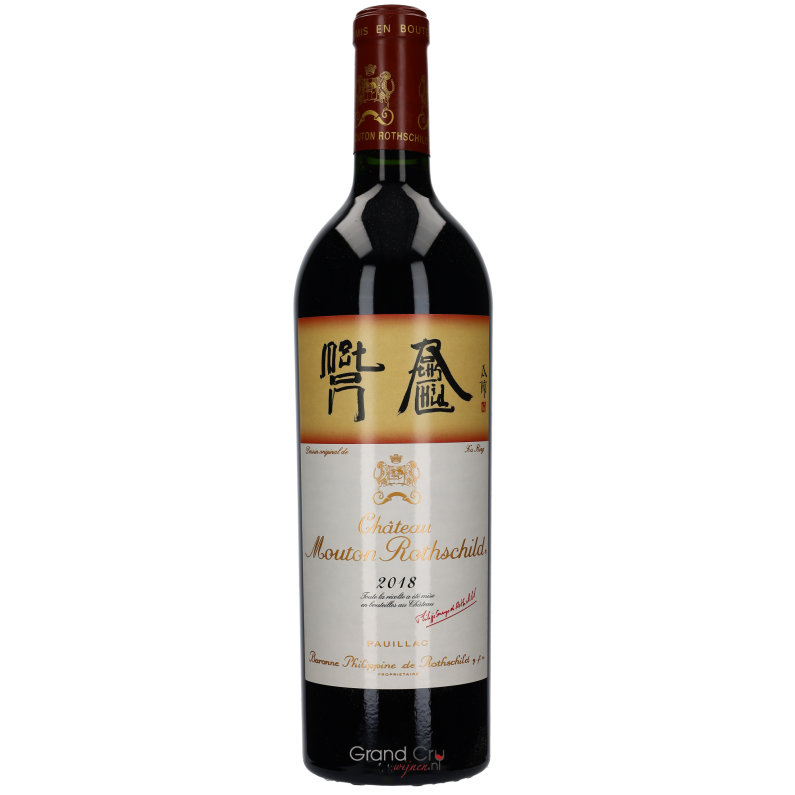
2018 Château Mouton Rothschild 1er Grand Cru Classe
| Type of Wine | |
|---|---|
| Country | France |
| Region | |
| Appellation | Pauillac |
| Winery | |
| Vintage | 2018 |
| Grape | , , |
| Content (Alc) | Standard (0.75 ltr) (14%) |
| Drink window | 2027 - 2067 |
Ordering in bulk? Log in to request a quote
In stock
6 items available
Notities
Foto
Proefnotities
Heb je deze wijn geproefd?
Bewaar je beoordeling en aantekeningen.
Bewaar je beoordeling en aantekeningen.
Heb je deze wijn geproefd?
Log in om je proefnotitie op te slaan.
Log in om je proefnotitie op te slaan.
InloggenHoe wil je je wijn beoordelen?
Max 5 MB. JPG, PNG, WebP.
Hoe smaakt het?
Klik op wat het beste past. Alles is optioneel.
Welke geuren en smaken herken je?
Klik op alles wat je herkent. Dit is optioneel.
Uiterlijk
Neus
Aroma's (neus)
Smaak
Smaken (mond)
Afdronk
Wijngegevens
Automatisch ingevuld vanuit productgegevens.
Persoonlijke gegevens
The vineyards of Château Mouton Rothschild are located northwest of Bordeaux, on the edge of the Medoc. The vines are planted on a narrow strip of land 80 km long and 5 to 10 km wide, close to the river, which moderates temperature differences. Bordering the northern border of the Landes forest, the Medoc benefits from the mildness of the maritime climate while being protected. In 1855, the best 61 wines from the Haut-Médoc were qualified as 'Grand Cru Classé', again subdivided into the 1st to the 5th Cru. The selection was based on the prices paid for the wines since about 1750. The 1st cru include Château Lafite, Latour, Margaux, and Haut-Brion. In 1973, Château Mouton was added to these four.
Pauillac is located on the Gironde, northwest of the city of Bordeaux. Pauillac (1,200 ha) is one of the best wine regions in the Haut-Médoc and is located below Saint-Estèphe. The village has 3 Premier Grands Cru Classé's: Château Latour, Château Lafite Rothschild and Château Mouton Rothschild. A total of 18 Grand Cru Classés from Pauillac account for 80% of the vineyard area in this commune. The top layer of this wine region consists of pebble, with a subsoil of clay and limestone.
The Mouton Rothschild 2018 is a blend of 86% Cabernet Sauvignon, 12% Merlot and 2% Cabernet Franc. There is also a dash of Petit Verdot in there, but that isn't even reflected in the percentage. The alcohol content is 13.8%, which is relatively modest for the vintage. Deep garnet purple in color, it immediately pops with bright, vibrant notes of blackcurrant, blackberry and redcurrant jelly with slowly emerging nuances of candied violets, stewed plums, licorice and black tea, plus a hint of dusty red earth. Built like a brick house with super firm, super ripe, grainy tannins and bold freshness supporting the muscular black fruit, this medium-bodied wine finishes long and savory with lingering mineral aftertaste.
“We only suffered 2% loss due to mildw in 2018,” said Managing Director Philippe Dhalluin. “But we had low yields on all the deep gravelly soils because of the dry period, more so at Mouton than at Clerc Milon. Clerc Milon has three meters of gravel before you get to the clay and limestone that holds the water. At Mouton there are six meters of gravel before you get to the clay and limestone.” This made for yields of 28 hectoliters per hectare at Mouton Rothschild, while Clerc Milon came in at 32 hectoliters per hectare, and the average for Pauillac was around 38 hectoliters per hectare. “In late September, it was still hot during the days, around 32 degrees Celsius, but the night temperatures dropped down to around seven degrees to allow the ripening to slow down,” Dhalluin said, explaining how the berries made it over that magic finish line to full phenolic (tannin) ripeness. All the Baron Philippe de Rothschild 2018 wines were blended early, from the end of November through early December, because the ferments went quite quickly. A lot of Merlot went into the second wines this year. Dhalluin commented that the Merlots were amazing this year, but Cabernet was even better.
FACT : The wine is stored in our conditioned Wine Warehouse and if you pick up the wine you will often receive a nice discount. You will immediately see the possible discount if you choose Pickup in the Checkout page. We are almost next to the Rijksweg with plenty of parking. Click here for address.
| Block Bundle Options | No |
|---|---|
| Type of Wine | Red |
| Country | France |
| Region | Bordeaux |
| Appellation | Pauillac |
| Icons | Icon France |
| Winery | Chateau Mouton Rothschild |
| Grape | Cabernet Franc, Cabernet Sauvignon, Merlot |
| Biological certified | No |
| Natural wine | No |
| Vegan | No |
| Vintage | 2018 |
| Drinking as of | 2027 |
| Drinking till | 2067 |
| Alcohol % | 14 |
| Alcohol free/low | No |
| Content | Standard (0.75 ltr) |
| Oak aging | Yes |
| Sparkling | No |
| Dessert wine | No |
| Closure | Cork |
| Parker rating | 99 |
| James Suckling rating | 100 |
| Vinous rating | 99 |
| Tasting Profiles | Complex, Donker fruit, Droog, Houtgerijpt, Krachtig, Mineraal, Tannines |
| Drink moments | Indruk maken, Lekker luxe, Open haard |
| Sommy Pairing Beschrijving | De 2018 Château Mouton Rothschild toont levendige zwarte bessen en bramen met tonen van rode bessengelei, gekonfijte viooltjes, gestoofde pruim, zoethout en zwarte thee, ondersteund door super rijpe, korrelige tannines, frisse zuurgraad en een lange, minerale, hartige afdronk. Door die stevige tannines, de frisse zuurstructuur en het geconcentreerde zwarte fruit snijdt deze wijn prachtig bij rijk rood vlees, lam, wild en stevige stoofschotels; de tannines binden met vet en eiwitten terwijl de fruit- en kruidenaroma's harmonie geven aan de gegarneerde, umami-rijke smaken. Nog beter tot zijn recht komt hij bij gegrilde of geroosterde, vetrandige stukken zoals ribeye of carré van lam, bij langzaam gegaarde of gestoofde bereidingen zoals ossobuco of hertenstoof en bij kruidige jus of reducties die de complexe tonen van de wijn accentueren. |
Parker
The Wine Advocate
RP 99
Reviewed by: Lisa Perrotti-Brown
Drink Date: 2027 - 2067
The 2018 Mouton Rothschild is a blend of 86% Cabernet Sauvignon, 12% Merlot and 2% Cabernet Franc—there is also a splash of all the Petit Verdot they had, but it doesn’t even register in the percentage. It has 13.8% alcohol, which is relatively modest for the vintage. Deep garnet-purple colored, it straight away pops with bright, vivacious notes of crushed blackcurrants, juicy blackberries and redcurrant jelly with slowly emerging nuances of candied violets, stewed plums, licorice and black tea, plus a waft of dusty red soil. The medium-bodied palate is built like a brick house with super firm, super ripe, grainy tannins and bold freshness supporting the muscular black fruits, finishing long and savory with lingering mineral suggestions. This is so, so delicious and, due to the ripeness of tannins, approachable now. It will be difficult to keep your mitts off it for a good 5-7 years, when all those tightly tucked away nuances should begin to emerge. After that, it should improve over the course of 25 years or more and drink for 40+.
“We only suffered 2% loss due to mildew in 2018,” Managing Director Philippe Dhalluin informed me. “But we had low yields on all the deep gravelly soils because of the dry period, more so at Mouton than at Clerc Milon. Clerc Milon has three meters of gravel before you get to the clay and limestone that holds the water. At Mouton there are six meters of gravel before you get to the clay and limestone.” This made for yields of 28 hectoliters per hectare at Mouton Rothschild, while Clerc Milon came in at 32 hectoliters per hectare, and the average for Pauillac was around 38 hectoliters per hectare. “In late September, it was still hot during the days, around 32 degrees Celsius, but the night temperatures dropped down to around seven degrees to allow the ripening to slow down,” Dhalluin said, explaining how the berries made it over that magic finish line to full phenolic (tannin) ripeness. All the Baron Philippe de Rothschild 2018 wines were blended early, from the end of November through early December, because the ferments went quite quickly. A lot of Merlot went into the second wines this year. Dhalluin commented that the Merlots were amazing this year, but Cabernet was even better.
Published: Mar 31, 2021
Lorem ipsum dolor sit amet, consectetur adipiscing elit. Sed do eiusmod tempor incididunt ut labore et dolore magna aliqua...
James Suckling
CHÂTEAU MOUTON ROTHSCHILD PAUILLAC 2018
Thursday, October 17, 2019
Country : France
Region : Bordeaux
Vintage : 2018
Score : 100
I am a little bit speechless about this one. I have not seen such earthy and totally deep character of the soil in a young Mouton in my career. Of course, I didn’t taste 1945 or 1959 when they were young, but I have been lucky enough to have a few bottles in my life. There is really terroir-driven character to this. Layered and so intense with polished and incredible tannins.
Lorem ipsum dolor sit amet, consectetur adipiscing elit. Sed do eiusmod tempor incididunt ut labore et dolore magna aliqua...
Vinous
99
Drinking Window
2028 - 2058
From: Bordeaux 2018: Not Back in Black (Mar 2021)
The 2018 Mouton Rothschild is a rich, shockingly flamboyant wine endowed with tremendous fruit density and a level of unctuousness that could be taken for a wine still in barrel. Marvelously open and fleshy, the 2018 is utterly breathtaking today. I imagine it will shut down at some point, but today it is all seduction here. Ripe red cherry, plum, mocha, spice and cedar infuse the 2018 with tons of complexity. This is a tremendous showing.
- By Antonio Galloni on March 2021
Lorem ipsum dolor sit amet, consectetur adipiscing elit. Sed do eiusmod tempor incididunt ut labore et dolore magna aliqua...
Exclusive Content
Sign in to unlock professional wine reviews from world-renowned critics
Château Mouton Rothschild is an icon of Pauillac. This legendary estate combines a rich history, unique terroir, and wines that belong to the very top worldwide. A name that fascinates wine lovers and collectors generation after generation.
History of Château Mouton Rothschild
In 1853, Baron Nathaniel de Rothschild bought the Château Brane-Mouton estate in Pauillac and renamed it Château Mouton Rothschild. His aim was to serve his own wine to his distinguished guests. In 1922, his great-grandson Philippe de Rothschild took over. Two years later, he decided that all wines should be bottled at the château itself — a revolutionary move in Bordeaux at the time. In 1973, Château Mouton Rothschild was officially promoted to Premier Grand Cru Classé, the only change ever made to the famous 1855 classification.
Later, Baroness Philippine de Rothschild took the helm. She modernized the estate and in 1962 opened a museum on the property. After her passing in 2014, the château came under the leadership of her children Camille, Philippe Sereys de Rothschild, and Julien de Beaumarchais, keeping it very much a family affair.
Location and terroir in Pauillac
Château Mouton Rothschild is located in Pauillac, at the heart of the Médoc, close to the Gironde estuary. The vineyards benefit from the mild maritime climate and the protection of the nearby Les Landes forest. The soil is made up of gravel over layers of clay and limestone. This unique combination delivers powerful yet elegant wines with great ageing potential.
Pauillac itself is one of Bordeaux’s most prestigious appellations. The village is home to three Premier Grands Crus Classés: Château Latour, Château Lafite Rothschild, and of course Château Mouton Rothschild.
Grapes and winemaking at Château Mouton Rothschild
The estate covers about 90 hectares of vineyards. Plantings are dominated by Cabernet Sauvignon, which makes up more than eighty percent. Merlot, Cabernet Franc, and a small portion of Petit Verdot complete the blend. Together they provide wines with depth, structure, and complexity.
The grapes are hand-harvested and carefully selected. In the impressive cellars, they are vinified in modern oak vats, with each parcel treated separately. This ensures that the character of each plot can fully express itself in the final wine.
Special wines from the estate
Alongside the Grand Vin, the château also produces a second wine: Le Petit Mouton. Made from younger vines, it is approachable earlier in its life. There is also a white wine, Aile d’Argent, crafted from Sauvignon Blanc, Sémillon, Sauvignon Gris, and a touch of Muscadelle. Fresh, aromatic, and released only in small quantities.
Another signature of Château Mouton Rothschild is the label art. Since 1945, a world-renowned artist has been commissioned each year to design a unique label. Names such as Picasso, Miró, and Warhol have all contributed, making these bottles true collector’s items.
Key facts to remember
- Château Mouton Rothschild is the only estate ever promoted to Premier Grand Cru Classé.
- The estate houses its own wine museum, celebrating the link between wine and art.
- The second wine Le Petit Mouton and the white Aile d’Argent are highly sought after by enthusiasts.
- The iconic labels are redesigned each year by major artists and are famous worldwide.
Order Château Mouton Rothschild online?
At Grandcruwijnen you can safely order Château Mouton Rothschild and the estate’s other wines online. All bottles are stored in a temperature-controlled Wine Warehouse. Prefer to pick up your wines yourself? Then you’ll enjoy an instant discount, which becomes visible at checkout when you select ‘Pickup’.
De 2018 Château Mouton Rothschild toont levendige zwarte bessen en bramen met tonen van rode bessengelei, gekonfijte viooltjes, gestoofde pruim, zoethout en zwarte thee, ondersteund door super rijpe, korrelige tannines, frisse zuurgraad en een lange, minerale, hartige afdronk. Door die stevige tannines, de frisse zuurstructuur en het geconcentreerde zwarte fruit snijdt deze wijn prachtig bij rijk rood vlees, lam, wild en stevige stoofschotels; de tannines binden met vet en eiwitten terwijl de fruit- en kruidenaroma's harmonie geven aan de gegarneerde, umami-rijke smaken. Nog beter tot zijn recht komt hij bij gegrilde of geroosterde, vetrandige stukken zoals ribeye of carré van lam, bij langzaam gegaarde of gestoofde bereidingen zoals ossobuco of hertenstoof en bij kruidige jus of reducties die de complexe tonen van de wijn accentueren.
Click on a category to discover delicious recipes that pair perfectly with this wine.
Do you already have a dish in mind?
Let our AI sommelier help you find the ideal wine for your dish
Start the Sommy Wine Advice Tool