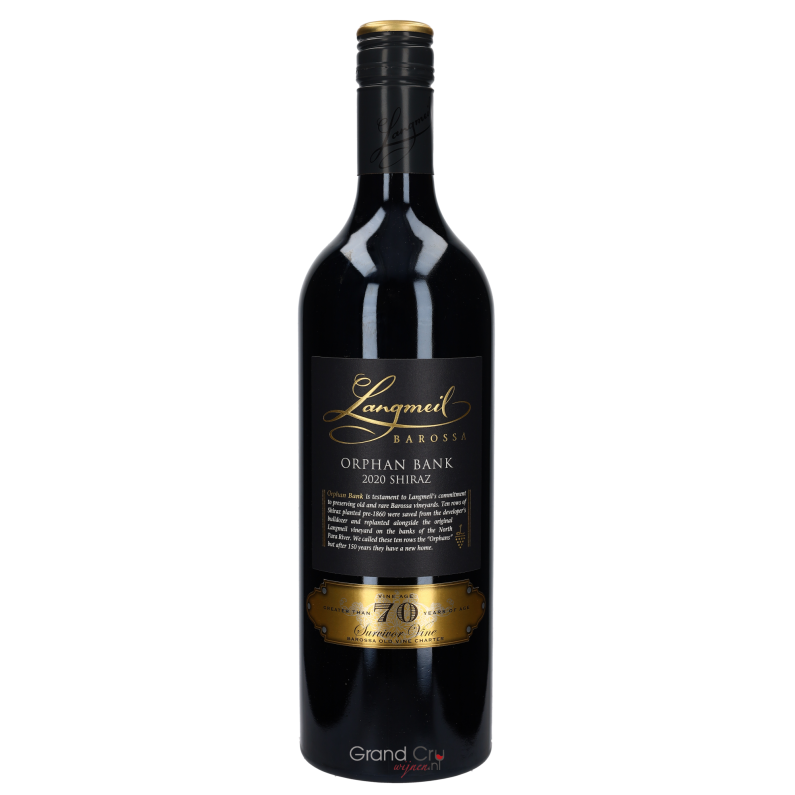
2020 Langmeil Orphan Bank Shiraz
| Type of Wine | Red |
|---|---|
| Country | Australia |
| Region | |
| Winery | |
| Vintage | 2020 |
| Grape | Syrah-Shiraz |
| Content (Alc) | 0.75 ltr (14.5%) |
| Drink window | 2024 - 2034 |
Description
Orphan Bank is witness to Langmeil's commitment to the preservation of the ancient and rare Barossa vineyards. Ten rows of Shiraz planted before 1860 were rescued from a developer's bulldozer and replanted next to the original vineyard on the banks of the Para River. These ten rows are called the "Orphans". This wine is made from 100% Shiraz. The vines are on average older than 104 years and grow on soils of red clay and limestone. The wine matures for 24 months in 56% new and 44% used French oak 'Hogshead'.
The wine has a warm scarlet red color with purple reflections. The rich aromas of red and blue fruits, violets and cedar mingle with hints of sage, chocolate and white pepper. Juicy raspberry and plum fill the mouth, complimented by the sweetness of the oak. The wild rose and white pepper balance the wine well, together with the texture and fine tannins. Delicious in combination with grilled meat and game.
Specifications
| Block Bundle Options | No |
|---|---|
| Type of Wine | Red |
| Country | Australia |
| Region | Barossa |
| Winery | Langmeil |
| Grape | Syrah-Shiraz |
| Biological certified | No |
| Natural wine | No |
| Vegan | No |
| Vintage | 2020 |
| Drinking as of | 2024 |
| Drinking till | 2034 |
| Alcohol % | 14.5 |
| Alcohol free/low | No |
| Content | 0.75 ltr |
| Oak aging | Yes |
| Sparkling | No |
| Dessert wine | No |
| Closure | Cork |
Wijnhuis
With a rich tradition dating back to 1842 and a unique European (Oberschlesien) influence, Barossa Valley has become Australia's most famous wine region. Achieving five stars in James Halliday's Wine Companion in six consecutive years has made Langmeil one of the leading wine producers in the area. The objective of this winery is to make top wine that comes 100% from Barossa and from grape varieties that excel in this area. Although some of its vineyards are much older, Langmeil was founded in 1996 by three friends: Chris Bitter, Carl Lindner and Richard Lindner. The original winery, which had been located on the estate since 1930, closed in 1988 and sat there untouched until 1996. The careful restoration of this took years.
Today, the Chief Winemaker Paul Lindner oversees the vinification process and pays particular attention to the making of wine from individual vineyards, minimal handling and careful filtration in order to guarantee distinctly well-balanced wines with subtle complexity. Langmeil shows that Barossa is capable of producing not only easily approachable wines, but also more complex varieties with excellent aging potential.
Doomed to make way for house building, ten rows of 140-year-old Shiraz vines were rescued by Langmeil and relocated. This saved part of the Barossa heritage. These 'orphans' share the same ancestry as their Freedom vineyard, planted in 1800 on what then had the same allotment: 'section 36, Hundred of Moorooroo'. When Christian Auricht died in 1860, this 'family' of Shiraz was split up. 146 years later, with the generous help of the Langmeil team as adoptive parents, the winery has managed to bring the herd back together.
Orphan Bank is witness to Langmeil's commitment to the preservation of the ancient and rare Barossa vineyards. Ten rows of Shiraz planted before 1860 were rescued from a developer's bulldozer and replanted next to the original vineyard on the banks of the Para River. These ten rows are called the "Orphans". This wine is made from 100% Shiraz. The vines are on average older than 104 years and grow on soils of red clay and limestone. The wine matures for 24 months in 56% new and 44% used French oak 'Hogshead'.
The wine has a warm scarlet red color with purple reflections. The rich aromas of red and blue fruits, violets and cedar mingle with hints of sage, chocolate and white pepper. Juicy raspberry and plum fill the mouth, complimented by the sweetness of the oak. The wild rose and white pepper balance the wine well, together with the texture and fine tannins. Delicious in combination with grilled meat and game.
| Block Bundle Options | No |
|---|---|
| Type of Wine | Red |
| Country | Australia |
| Region | Barossa |
| Winery | Langmeil |
| Grape | Syrah-Shiraz |
| Biological certified | No |
| Natural wine | No |
| Vegan | No |
| Vintage | 2020 |
| Drinking as of | 2024 |
| Drinking till | 2034 |
| Alcohol % | 14.5 |
| Alcohol free/low | No |
| Content | 0.75 ltr |
| Oak aging | Yes |
| Sparkling | No |
| Dessert wine | No |
| Closure | Cork |
With a rich tradition dating back to 1842 and a unique European (Oberschlesien) influence, Barossa Valley has become Australia's most famous wine region. Achieving five stars in James Halliday's Wine Companion in six consecutive years has made Langmeil one of the leading wine producers in the area. The objective of this winery is to make top wine that comes 100% from Barossa and from grape varieties that excel in this area. Although some of its vineyards are much older, Langmeil was founded in 1996 by three friends: Chris Bitter, Carl Lindner and Richard Lindner. The original winery, which had been located on the estate since 1930, closed in 1988 and sat there untouched until 1996. The careful restoration of this took years.
Today, the Chief Winemaker Paul Lindner oversees the vinification process and pays particular attention to the making of wine from individual vineyards, minimal handling and careful filtration in order to guarantee distinctly well-balanced wines with subtle complexity. Langmeil shows that Barossa is capable of producing not only easily approachable wines, but also more complex varieties with excellent aging potential.
Doomed to make way for house building, ten rows of 140-year-old Shiraz vines were rescued by Langmeil and relocated. This saved part of the Barossa heritage. These 'orphans' share the same ancestry as their Freedom vineyard, planted in 1800 on what then had the same allotment: 'section 36, Hundred of Moorooroo'. When Christian Auricht died in 1860, this 'family' of Shiraz was split up. 146 years later, with the generous help of the Langmeil team as adoptive parents, the winery has managed to bring the herd back together.
 Follow the latest news about all our wines, promotions, and new selections.