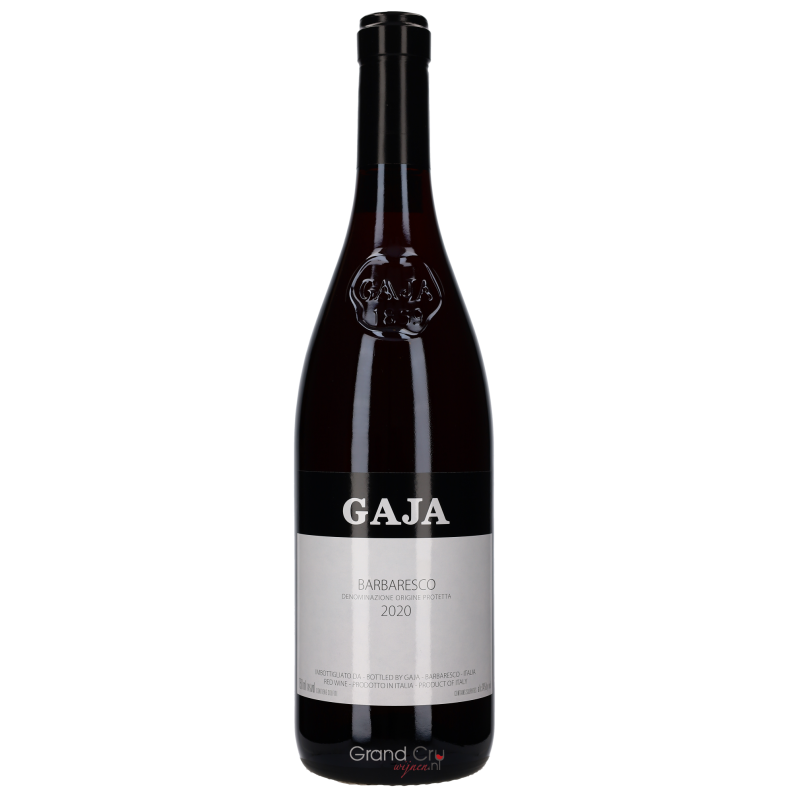
2020 Gaja Barbaresco
| Type of Wine | Red |
|---|---|
| Country | Italy |
| Region | |
| Appellation | Barbaresco |
| Winery | |
| Vintage | 2020 |
| Grape | |
| Content (Alc) | 0.75 ltr (14%) |
| Drink window | 2025 - 2045 |
Description
The historical showpiece and the most important wine of the family is the 'Barbaresco'! Like the Barolo, it is extracted from the Nebbiolo grape and was first freed from an excess of hard tannins at Gaja, which made the wine more accessible and gave it a multitude of finesses. The 'Koninginnewijn' has a beautiful scent of cassis and cherries, leather and earth, tobacco and licorice. With all the power and fullness that characterize wines from the Nebbiolo grape, it is known for its elegance and fine silky tannin. The Barbaresco is a fusion of brilliant delicacy and extreme concentration. Full of finesse and extremely aromatic.
Gaja Baresco is vinified 100% from Nebbiolo. The grapes were picked manually in October from wine strains from 14 different plots of the Gaja winery. After fermentation, the wine matured for 12 months in new barriques, then another 12 months in large wooden barrels, before the oenologist Guido Rivella released it. The wine has a storage potential of at least 10 – 20 years, with perfect storage conditions even longer.
The historical showpiece and the most important wine of the family is the 'Barbaresco'! Like the Barolo, it is extracted from the Nebbiolo grape and was first freed from an excess of hard tannins at Gaja, which made the wine more accessible and gave it a multitude of finesses. The 'Koninginnewijn' has a beautiful scent of cassis and cherries, leather and earth, tobacco and licorice. With all the power and fullness that characterize wines from the Nebbiolo grape, it is known for its elegance and fine silky tannin. The Barbaresco is a fusion of brilliant delicacy and extreme concentration. Full of finesse and extremely aromatic.
The history of wine house Gaja begins in 1859, the year in which Giovanni Gaja, a local grape grower in Barbaresco, Piemonte, founded a small wine company under his own name. A generation later, it is Angelo, grandfather of the current owner, who continues to make wine with the same determination as his father. He is supported in this by Clotilde Rey, whom he marries in 1905. They teach their scion Giovanni named after his grandfather that as a winemaker you should not make any concessions; nothing should be at the expense of the quality of the wine. In 1961, Giovanni's son Angelo joins the family business. After graduating as an economist from the University of Turin and graduating from the School of Viticulture & Oenology in Alba, young Angelo went abroad for an internship in wineries in Bordeaux, Burgundy, along the Rin and in California. Full of fresh ideas, he had now returned to his native Piedmont.
When Angelo Gaja takes over the company from his parents in 1970, he asks his old classmate and winemaker Guido Rivella to assist him. Together they implement a number of very revolutionary changes for the region. For example, they sometimes reduce the yields per hectare by up to half the number of liters allowed, they experiment with vinification methods, the planting of new grape varieties - both red and white - and pioneering ripening techniques. The results are amazing and Gaja is conquering the whole world with its beautiful Barbarescos - the company's flagship.
The nebbiolo grapes for the Barbaresco of Gaja traditionally came from different vineyards. That's how Angelo's father, grandfather and his father before that did it. Although the young Angelo would not end this tradition, he launched a new line of Barbarescos from a single vineyard. There was increasing interest in these experimental single vinyard wines.
As a proponent of a dynamic, purely quality-oriented viticultural culture, the brilliant winemaker decided from 1996 to break completely with what he considered too conservative and restrictive Italian system of designations of origin. Only his traditional Barbaresco is still on the market as a prestigious DOCG. He deliberately 'downgrades' all other red single vineyard wines to regional Langhe Nebbiolo DOC. They are the Sorì San Lorenzo, the Sorì Tildìn and the Costa Russi.
Gaja' Barolo Sperss also underwent the same name change. With the exception of Dagromis Barolo DOCG, Sito Moresco and Conteisa de Langhe DOC are also mentioned. Langhe DOC also appears on the label of his white toppers from Piemonte, the Rossj-Bass, Alteni di Brassica and Gaia & Rey. After all, for Gaja it is not the abbreviation that guarantees good quality of a wine, but the name of the producer.
Specifications
| Block Bundle Options | No |
|---|---|
| Type of Wine | Red |
| Country | Italy |
| Region | Piemonte |
| Appellation | Barbaresco |
| Icons | Icon Italy |
| Winery | Gaja |
| Grape | Nebbiolo |
| Biological certified | No |
| Natural wine | No |
| Vegan | No |
| Vintage | 2020 |
| Drinking as of | 2025 |
| Drinking till | 2045 |
| Alcohol % | 14 |
| Alcohol free/low | No |
| Content | 0.75 ltr |
| Oak aging | Yes |
| Sparkling | No |
| Dessert wine | No |
| Closure | Cork |
| Parker rating | 96 |
| James Suckling rating | 95 |
| Vinous rating | 94 |
| Tasting Profiles | Earthy, Rustic, Complex, Dry, Aged on wood, Powerful, Mineral, Red fruit, Tannines, Full |
| Drink moments | Lekker luxe, Met vrienden |
Professional Reviews
Parker
Rating
96
Release Price
NA
Drink Date
2022 - 2045
Reviewed by
Monica Larner
Issue Date
28th Jun 2019
Source
Issue 243 End of June 2019, The Wine Advocate
I tasted this wine over two sittings, one at the winery and one at my home office a few weeks later. Although I can't claim any extraordinary differences between the two sessions, I noticed a few minimal shifts that are essential to understanding the wine's future aging ability. The 2016 Barbaresco starts off slow at first, showing a small margin of aromatic evolution in the glass. But come back two hours later, and you can almost hear the soft sounds of the symphony playing just below the surface. The 2016 vintage is characterized by the solid intensity and firmness of its aromas, which transcend fruit and veer toward balsamic herb, licorice, tar and smoke instead. The tannins offer a moment of sweetness and softness, before you are aware of their undeniable firmness. In all, there is a certain glossiness or satiny quality to the mouthfeel that underlines the wine's carefully crafted integration. I would describe this as a classic and also a somewhat austere Barbaresco that fully deserves extra cellar time to stretch those tight muscles and grow in volume. This wine will award those who wait.
During my visit to the Gaja estate this May, I preview tasted samples of the single-vineyard 2016 Barbaresco Costa Russi, the 2016 Barbaresco Sorì San Lorenzo, the 2016 Barbaresco Sorì Tildìn, the 2015 Barolo Conteisa, the 2015 Barolo Sperss and the 2016 Cabernet Sauvignon Darmagi. I tasted these wines before they went into bottle, and they were not ready for review. I am returning to Barbaresco later this summer and will deliver my full notes from the Gaja family in a second report to follow. For now, I am only publishing a review of the 2016 Barbaresco and the white wines.
Lorem ipsum dolor sit amet, consectetur adipiscing elit. Sed do eiusmod tempor incididunt ut labore et dolore magna aliqua...
James Suckling
Lorem ipsum dolor sit amet, consectetur adipiscing elit. Sed do eiusmod tempor incididunt ut labore et dolore magna aliqua...
Vinous
93+
Drinking Window
2025 - 2039
From: Focus on Barbaresco – A Close Look at 2019 & 2020 (Oct 2022)
Gaja's 2019 Barbaresco is gorgeous. Bright and nervy, with fabulous balance, the 2019 captures all the best this tricky vintage had to offer. Gaja did not bottle any other Barbaresco crus, opting to use the best lots for this bottling. That decision paid off in a 2019 that sizzles with tension. The aromatics alone are captivating. Bright acids lend vibrancy to a core of beautifully delineated Nebbiolo fruit. I can't wait to see how this ages.
- By Antonio Galloni on September 2022
Lorem ipsum dolor sit amet, consectetur adipiscing elit. Sed do eiusmod tempor incididunt ut labore et dolore magna aliqua...
Exclusive Content
Sign in to unlock professional wine reviews from world-renowned critics
Wijnhuis
The history of winery Gaja starts in 1859, the year in which Giovanni Gaja, a local grape grower in Barbaresco, Piemonte, founded a wine company under his own name. A generation later, it is Angelo, grandfather of the current owner, who continues to make wine with the same determination as his father. He is supported in this by Clotilde Rey with whom he marries in 1905. They teach their scion Giovanni named after his grandfather so that as a winemaker you should not make any concessions; nothing should be at the expense of the quality of the wine.
In 1961 Giovannis son Angelo works in the family business. After graduating as an economist from the University of Turin and graduating from the School of Viticulture & Oenology in Alba, the young Angelo left abroad for an internship at wine farms in Bordeaux, Burgundy, along the Rin and in California. Full of fresh ideas, he had now returned to his native Piemonte. When Angelo Gaja took over his parents' company in 1970, he asked his old classmate and winemaker Guido Rivella to assist him. Together they implement a number of revolutionary changes for the region. For example, they sometimes reduce yields per hectare by up to half the number of liters allowed, they experiment with vinification methods, the planting of new - both red and white - grape varieties and pioneering ripening techniques. The results are astonishing and Gaja conquers the world with his beautiful Barbaresco's - the company's flagship.
The nebbiolo grapes for the Barbaresco of Gaja traditionally came from different vineyards. Angelos' father, grandfather and his father did just that before. Although young Angelo would not end this tradition, he launched a new line of Barbaresco's from a single vineyard. Interest in these experimental single vinyard wines became more and more popular. As a proponent of a dynamic, purely quality-oriented wine culture, the brilliant winemaker decides from 1996 to completely break with what he considers to be a conservative and restrictive Italian designation of origin. Only his traditional Barbaresco is still on the market as a prestigious DOCG. He deliberately 'declassifies' all other red single vineyard wines into regional Langhe Nebbiolo DOC. These are the Sorì San Lorenzo, the Sorì Tildìn and the Costa Russi. Gajas Barolo Sperss also underwent the same name change. With the exception of the Dagromis Barolo DOCG, Sito Moresco and Conteisa de Langhe also bear DOC. Langhe DOC is also on the label of his white toppers from Piemonte, the Rossj-Bass, Alteni di Brassica and Gaia & Rey. After all, for Gaja the abbreviation does not guarantee good quality of a wine but the name of the producer.
The historical showpiece and the most important wine of the family is the 'Barbaresco'! Like the Barolo, it is extracted from the Nebbiolo grape and was first freed from an excess of hard tannins at Gaja, which made the wine more accessible and gave it a multitude of finesses. The 'Koninginnewijn' has a beautiful scent of cassis and cherries, leather and earth, tobacco and licorice. With all the power and fullness that characterize wines from the Nebbiolo grape, it is known for its elegance and fine silky tannin. The Barbaresco is a fusion of brilliant delicacy and extreme concentration. Full of finesse and extremely aromatic.
Gaja Baresco is vinified 100% from Nebbiolo. The grapes were picked manually in October from wine strains from 14 different plots of the Gaja winery. After fermentation, the wine matured for 12 months in new barriques, then another 12 months in large wooden barrels, before the oenologist Guido Rivella released it. The wine has a storage potential of at least 10 – 20 years, with perfect storage conditions even longer.
The historical showpiece and the most important wine of the family is the 'Barbaresco'! Like the Barolo, it is extracted from the Nebbiolo grape and was first freed from an excess of hard tannins at Gaja, which made the wine more accessible and gave it a multitude of finesses. The 'Koninginnewijn' has a beautiful scent of cassis and cherries, leather and earth, tobacco and licorice. With all the power and fullness that characterize wines from the Nebbiolo grape, it is known for its elegance and fine silky tannin. The Barbaresco is a fusion of brilliant delicacy and extreme concentration. Full of finesse and extremely aromatic.
The history of wine house Gaja begins in 1859, the year in which Giovanni Gaja, a local grape grower in Barbaresco, Piemonte, founded a small wine company under his own name. A generation later, it is Angelo, grandfather of the current owner, who continues to make wine with the same determination as his father. He is supported in this by Clotilde Rey, whom he marries in 1905. They teach their scion Giovanni named after his grandfather that as a winemaker you should not make any concessions; nothing should be at the expense of the quality of the wine. In 1961, Giovanni's son Angelo joins the family business. After graduating as an economist from the University of Turin and graduating from the School of Viticulture & Oenology in Alba, young Angelo went abroad for an internship in wineries in Bordeaux, Burgundy, along the Rin and in California. Full of fresh ideas, he had now returned to his native Piedmont.
When Angelo Gaja takes over the company from his parents in 1970, he asks his old classmate and winemaker Guido Rivella to assist him. Together they implement a number of very revolutionary changes for the region. For example, they sometimes reduce the yields per hectare by up to half the number of liters allowed, they experiment with vinification methods, the planting of new grape varieties - both red and white - and pioneering ripening techniques. The results are amazing and Gaja is conquering the whole world with its beautiful Barbarescos - the company's flagship.
The nebbiolo grapes for the Barbaresco of Gaja traditionally came from different vineyards. That's how Angelo's father, grandfather and his father before that did it. Although the young Angelo would not end this tradition, he launched a new line of Barbarescos from a single vineyard. There was increasing interest in these experimental single vinyard wines.
As a proponent of a dynamic, purely quality-oriented viticultural culture, the brilliant winemaker decided from 1996 to break completely with what he considered too conservative and restrictive Italian system of designations of origin. Only his traditional Barbaresco is still on the market as a prestigious DOCG. He deliberately 'downgrades' all other red single vineyard wines to regional Langhe Nebbiolo DOC. They are the Sorì San Lorenzo, the Sorì Tildìn and the Costa Russi.
Gaja' Barolo Sperss also underwent the same name change. With the exception of Dagromis Barolo DOCG, Sito Moresco and Conteisa de Langhe DOC are also mentioned. Langhe DOC also appears on the label of his white toppers from Piemonte, the Rossj-Bass, Alteni di Brassica and Gaia & Rey. After all, for Gaja it is not the abbreviation that guarantees good quality of a wine, but the name of the producer.
| Block Bundle Options | No |
|---|---|
| Type of Wine | Red |
| Country | Italy |
| Region | Piemonte |
| Appellation | Barbaresco |
| Icons | Icon Italy |
| Winery | Gaja |
| Grape | Nebbiolo |
| Biological certified | No |
| Natural wine | No |
| Vegan | No |
| Vintage | 2020 |
| Drinking as of | 2025 |
| Drinking till | 2045 |
| Alcohol % | 14 |
| Alcohol free/low | No |
| Content | 0.75 ltr |
| Oak aging | Yes |
| Sparkling | No |
| Dessert wine | No |
| Closure | Cork |
| Parker rating | 96 |
| James Suckling rating | 95 |
| Vinous rating | 94 |
| Tasting Profiles | Earthy, Rustic, Complex, Dry, Aged on wood, Powerful, Mineral, Red fruit, Tannines, Full |
| Drink moments | Lekker luxe, Met vrienden |
Parker
Rating
96
Release Price
NA
Drink Date
2022 - 2045
Reviewed by
Monica Larner
Issue Date
28th Jun 2019
Source
Issue 243 End of June 2019, The Wine Advocate
I tasted this wine over two sittings, one at the winery and one at my home office a few weeks later. Although I can't claim any extraordinary differences between the two sessions, I noticed a few minimal shifts that are essential to understanding the wine's future aging ability. The 2016 Barbaresco starts off slow at first, showing a small margin of aromatic evolution in the glass. But come back two hours later, and you can almost hear the soft sounds of the symphony playing just below the surface. The 2016 vintage is characterized by the solid intensity and firmness of its aromas, which transcend fruit and veer toward balsamic herb, licorice, tar and smoke instead. The tannins offer a moment of sweetness and softness, before you are aware of their undeniable firmness. In all, there is a certain glossiness or satiny quality to the mouthfeel that underlines the wine's carefully crafted integration. I would describe this as a classic and also a somewhat austere Barbaresco that fully deserves extra cellar time to stretch those tight muscles and grow in volume. This wine will award those who wait.
During my visit to the Gaja estate this May, I preview tasted samples of the single-vineyard 2016 Barbaresco Costa Russi, the 2016 Barbaresco Sorì San Lorenzo, the 2016 Barbaresco Sorì Tildìn, the 2015 Barolo Conteisa, the 2015 Barolo Sperss and the 2016 Cabernet Sauvignon Darmagi. I tasted these wines before they went into bottle, and they were not ready for review. I am returning to Barbaresco later this summer and will deliver my full notes from the Gaja family in a second report to follow. For now, I am only publishing a review of the 2016 Barbaresco and the white wines.
Lorem ipsum dolor sit amet, consectetur adipiscing elit. Sed do eiusmod tempor incididunt ut labore et dolore magna aliqua...
James Suckling
Lorem ipsum dolor sit amet, consectetur adipiscing elit. Sed do eiusmod tempor incididunt ut labore et dolore magna aliqua...
Vinous
93+
Drinking Window
2025 - 2039
From: Focus on Barbaresco – A Close Look at 2019 & 2020 (Oct 2022)
Gaja's 2019 Barbaresco is gorgeous. Bright and nervy, with fabulous balance, the 2019 captures all the best this tricky vintage had to offer. Gaja did not bottle any other Barbaresco crus, opting to use the best lots for this bottling. That decision paid off in a 2019 that sizzles with tension. The aromatics alone are captivating. Bright acids lend vibrancy to a core of beautifully delineated Nebbiolo fruit. I can't wait to see how this ages.
- By Antonio Galloni on September 2022
Lorem ipsum dolor sit amet, consectetur adipiscing elit. Sed do eiusmod tempor incididunt ut labore et dolore magna aliqua...
Exclusive Content
Sign in to unlock professional wine reviews from world-renowned critics
The history of winery Gaja starts in 1859, the year in which Giovanni Gaja, a local grape grower in Barbaresco, Piemonte, founded a wine company under his own name. A generation later, it is Angelo, grandfather of the current owner, who continues to make wine with the same determination as his father. He is supported in this by Clotilde Rey with whom he marries in 1905. They teach their scion Giovanni named after his grandfather so that as a winemaker you should not make any concessions; nothing should be at the expense of the quality of the wine.
In 1961 Giovannis son Angelo works in the family business. After graduating as an economist from the University of Turin and graduating from the School of Viticulture & Oenology in Alba, the young Angelo left abroad for an internship at wine farms in Bordeaux, Burgundy, along the Rin and in California. Full of fresh ideas, he had now returned to his native Piemonte. When Angelo Gaja took over his parents' company in 1970, he asked his old classmate and winemaker Guido Rivella to assist him. Together they implement a number of revolutionary changes for the region. For example, they sometimes reduce yields per hectare by up to half the number of liters allowed, they experiment with vinification methods, the planting of new - both red and white - grape varieties and pioneering ripening techniques. The results are astonishing and Gaja conquers the world with his beautiful Barbaresco's - the company's flagship.
The nebbiolo grapes for the Barbaresco of Gaja traditionally came from different vineyards. Angelos' father, grandfather and his father did just that before. Although young Angelo would not end this tradition, he launched a new line of Barbaresco's from a single vineyard. Interest in these experimental single vinyard wines became more and more popular. As a proponent of a dynamic, purely quality-oriented wine culture, the brilliant winemaker decides from 1996 to completely break with what he considers to be a conservative and restrictive Italian designation of origin. Only his traditional Barbaresco is still on the market as a prestigious DOCG. He deliberately 'declassifies' all other red single vineyard wines into regional Langhe Nebbiolo DOC. These are the Sorì San Lorenzo, the Sorì Tildìn and the Costa Russi. Gajas Barolo Sperss also underwent the same name change. With the exception of the Dagromis Barolo DOCG, Sito Moresco and Conteisa de Langhe also bear DOC. Langhe DOC is also on the label of his white toppers from Piemonte, the Rossj-Bass, Alteni di Brassica and Gaia & Rey. After all, for Gaja the abbreviation does not guarantee good quality of a wine but the name of the producer.