2016 Gaja Brunello di Montalcino Sugarille
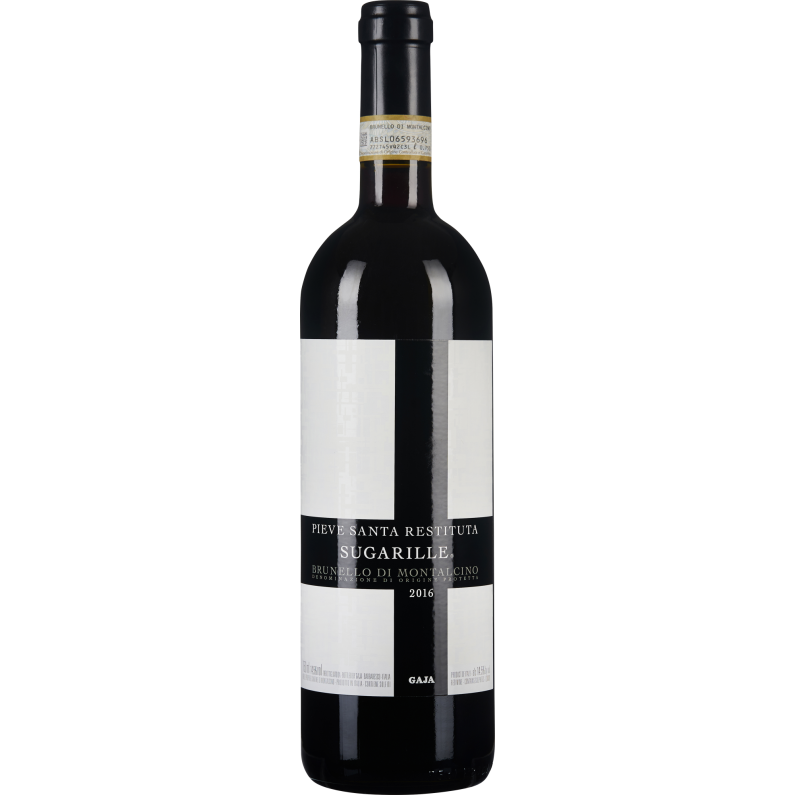
De specificaties zoals vermeld bij de wijn (o.a. wijnjaar) en in de titel zijn leidend en er kunnen geen rechten worden ontleend aan de afbeelding die wordt getoond. Lees meer in onze Frequenty asked questions
| Type of Wine | Red |
|---|---|
| Country | Italy |
| Region | Tuscany |
| Winery | |
| Vintage | 2016 |
| Grape | |
| Content (Alc) | 0.75 ltr (14%) |
| Drink window | 2024 - 2044 |
In stock
6 items available
Description
The history of the Gaja winery begins in 1859, the year in which Giovanni Gaja, a local grape grower in Barbaresco, Piedmont, founded a wine company under his own name. A generation later, it is Angelo, grandfather of the current owner, who continues making wine with the same determination as his father. He is supported in this by Clotilde Rey, whom he married in 1905. They teach their descendant Giovanni, named after his grandfather, that as a winemaker you should not make any concessions; nothing should be at the expense of the quality of the wine.
In 1961, Giovannis' son Angelo came to work in the family business. After graduating as an economist from the University of Turin and obtaining his diploma from the School of Viticulture & Oenology in Alba, the young Angelo went abroad for an internship at wine companies in Bordeaux, Burgundy, along the Rin and in California. Full of fresh ideas, he had now returned to his native Piedmont. When Angelo Gaja took over the company from his parents in 1970, he asked his old classmate and winemaker Guido Rivella to assist him. Together they implement a number of very revolutionary changes for the region. For example, they sometimes reduce yields per hectare by as much as half the number of permitted liters, they experiment with vinification methods, the planting of new - both red and white - grape varieties and groundbreaking ripening techniques. The results are astonishing and Gaja is conquering the whole world with its beautiful Barbarescos - the company's flagship.
It was one of Gaja's notable investments in Tuscany, acquiring the twelve hectare Pieve Santa Restituta, named after the local church (pieve). This meant that the production of Brunello di Montalcino suddenly became one of the company's new possibilities. In this region the conditions are ideal for the native sangiovese grape. The composition of the soil is perfect, so is the altitude of the orchards and the climate leaves nothing to be desired. The ambitious Angelo Gaja went to work with his team of winemakers. The Brunello di Montalcino Rennina – named after the piece of land of the same name located next to the church of Santa Restituta – and the Brunello di Montalcino Sugarille – after one of the vineyards of the same name on the Santa Restituta estate – were successively launched.
Only 6,000 bottles of this 2016 Brunello di Montalcino Sugarille were made. A wine made from 100% Sangiovese. This is a deep red colored wine with aromas of plums, berries, herbs, leather and truffle. The wine is extremely complex and full of black fruit. It is a velvety wine with lots of texture.
FACT : The wine is stored in our conditioned Wine Warehouse and if you pick up the wine you will often receive a nice discount. You will immediately see the possible discount if you choose Pickup in the Checkout page. We are almost next to the Rijksweg with plenty of parking. Click here for address.
Specifications
| Block Bundle Options | No |
|---|---|
| Type of Wine | Red |
| Country | Italy |
| Region | Tuscany |
| Icons | Icon Italy |
| Winery | Gaja |
| Grape | Sangiovese |
| Biological certified | No |
| Natural wine | No |
| Vegan | No |
| Vintage | 2016 |
| Drinking as of | 2024 |
| Drinking till | 2044 |
| Alcohol % | 14 |
| Alcohol free/low | No |
| Content | 0.75 ltr |
| Oak aging | Yes |
| Sparkling | No |
| Dessert wine | No |
| Closure | Cork |
| Parker rating | 95 |
| James Suckling rating | 98 |
| Vinous rating | 96 |
| Tasting Profiles | Earthy, Rustic, Complex, Dry, Aged on wood, Powerful, Spicy, Mineral, Red fruit, Tannines, Full |
| Drink moments | Indruk maken, Lekker luxe |
Professional Reviews
Parker
The Wine Advocate
RP 95
Reviewed by: Monica Larner
Drink Date: 2024 - 2043
The Pieve Santa Restituta 2016 Brunello di Montalcino Sugarille opens to the dark, fruity intensity that defines this five-hectare site with schistous clay galestro-rich soils. Sugarille always shows more heft and density, and this impression is amplified in a balanced vintage such as 2016. But with the memory of the 2015 vintage fresh in my mind, I feel that this edition is slightly lither and more streamlined in terms of mouthfeel. The tannins are direct and linear, but the fruit padding is lessened compared to the slightly warm 2015 vintage. In most cases, I prefer 2016 to 2015, but in the case of Sugarille (a 10,000-bottle release), I give a tiny upper hand to the older vintage thanks to its increased complexity and richer textural fiber.
Published: Nov 30, 2020
Lorem ipsum dolor sit amet, consectetur adipiscing elit. Sed do eiusmod tempor incididunt ut labore et dolore magna aliqua...
James Suckling
PIEVE SANTA RESTITUTA BRUNELLO DI MONTALCINO SUGARILLE 2016
Monday, December 21, 2020
Country :Italy
Region : Tuscany
Vintage : 2016
Score : 98
Plenty of black cherries, cedar, dried flowers and red cherries on the nose, following through to the palate, which is dense and compressed with gorgeous, intense fruit and chewy yet integrated tannins. Very, very impressive red here. Try after 2024.
Lorem ipsum dolor sit amet, consectetur adipiscing elit. Sed do eiusmod tempor incididunt ut labore et dolore magna aliqua...
Vinous
96
Drinking Window
2026 - 2040
From: 2016 Brunello di Montalcino: Radiance Personified (Nov 2020)
The 2016 Brunello di Montalcino Sugarille is a sleeping giant. Cool-toned, poised yet wonderfully elegant, it lifts from the glass with a gorgeous display of lavender and purple-tinged florals before giving way to crushed stone, blackberries and a hint of sour citrus. It’s silky and soft with a dense core of primary fruits, which creates a monolithic feel today yet tempts the imagination with what’s to come. Brisk acids, salty minerals and fine-grained tannins combine, adding clenching grip yet also further depths, tapering off to hints of tobacco and spiced orange. Its scale is large, yet so is its potential, as this well-muscled Brunello is geared for the cellar and sure to make a lot of people happy over the next ten to twenty years.
- By Eric Guido on November 2020
The Gaja family tends twenty-five hectares of vines between Tavernelle in the southwest of Montalcino and the Deserti area in the northeast. However, it’s only the vines in Tavernelle, a warm and dry part of Montalcino which is heavily influenced by the sea, that are used to create Rennina and the single-vineyard Brunello, Sugarille. All of the other fruit goes into making a Brunello which is not submitted for reviews and instead marketed to restaurants. While the family doesn’t have any intention of making any changes to this structure, Giovanni Gaja spoke excitedly about a recent acquisition of five hectares in Bolsignano, a valley in the southeast with a very unique microclimate from their current holdings. This parcel sits at elevations between 350-400 meters in galestro soils, with a large diurnal shift between day and nighttime temperatures. Starting with the 2019 vintage, this fruit will help fuel the estate’s Brunello; yet the area is undergoing a replanting project with another five hectares coming on board over the next few years. Ultimately, with global warming in mind, the Gaja family will now have the ability to blend fruit from both north to south and east to west, allowing them to find balance from vintage to vintage. What’s more, the winery has also begun to slowly introduce large, forty-hectoliter barrels throughout the range, with the goal of finding a balance between them and the tonneaux that they have used prior. In 2016 the Rennina was matured in a mix of 70% two-year-old large casks, with only 30% in tonneaux, while the Sugarille was matured in a mix of 60% two-year-old large casks, with only 40% in tonneaux. In the end, whether in Piedmont, Maremma, Montalcino or Mount Etna, the Gaja family always has a firm eye on the future.
Lorem ipsum dolor sit amet, consectetur adipiscing elit. Sed do eiusmod tempor incididunt ut labore et dolore magna aliqua...
Exclusive Content
Sign in to unlock professional wine reviews from world-renowned critics
Wijnhuis
The history of winery Gaja starts in 1859, the year in which Giovanni Gaja, a local grape grower in Barbaresco, Piemonte, founded a wine company under his own name. A generation later, it is Angelo, grandfather of the current owner, who continues to make wine with the same determination as his father. He is supported in this by Clotilde Rey with whom he marries in 1905. They teach their scion Giovanni named after his grandfather so that as a winemaker you should not make any concessions; nothing should be at the expense of the quality of the wine.
In 1961 Giovannis son Angelo works in the family business. After graduating as an economist from the University of Turin and graduating from the School of Viticulture & Oenology in Alba, the young Angelo left abroad for an internship at wine farms in Bordeaux, Burgundy, along the Rin and in California. Full of fresh ideas, he had now returned to his native Piemonte. When Angelo Gaja took over his parents' company in 1970, he asked his old classmate and winemaker Guido Rivella to assist him. Together they implement a number of revolutionary changes for the region. For example, they sometimes reduce yields per hectare by up to half the number of liters allowed, they experiment with vinification methods, the planting of new - both red and white - grape varieties and pioneering ripening techniques. The results are astonishing and Gaja conquers the world with his beautiful Barbaresco's - the company's flagship.
The nebbiolo grapes for the Barbaresco of Gaja traditionally came from different vineyards. Angelos' father, grandfather and his father did just that before. Although young Angelo would not end this tradition, he launched a new line of Barbaresco's from a single vineyard. Interest in these experimental single vinyard wines became more and more popular. As a proponent of a dynamic, purely quality-oriented wine culture, the brilliant winemaker decides from 1996 to completely break with what he considers to be a conservative and restrictive Italian designation of origin. Only his traditional Barbaresco is still on the market as a prestigious DOCG. He deliberately 'declassifies' all other red single vineyard wines into regional Langhe Nebbiolo DOC. These are the Sorì San Lorenzo, the Sorì Tildìn and the Costa Russi. Gajas Barolo Sperss also underwent the same name change. With the exception of the Dagromis Barolo DOCG, Sito Moresco and Conteisa de Langhe also bear DOC. Langhe DOC is also on the label of his white toppers from Piemonte, the Rossj-Bass, Alteni di Brassica and Gaia & Rey. After all, for Gaja the abbreviation does not guarantee good quality of a wine but the name of the producer.
The history of the Gaja winery begins in 1859, the year in which Giovanni Gaja, a local grape grower in Barbaresco, Piedmont, founded a wine company under his own name. A generation later, it is Angelo, grandfather of the current owner, who continues making wine with the same determination as his father. He is supported in this by Clotilde Rey, whom he married in 1905. They teach their descendant Giovanni, named after his grandfather, that as a winemaker you should not make any concessions; nothing should be at the expense of the quality of the wine.
In 1961, Giovannis' son Angelo came to work in the family business. After graduating as an economist from the University of Turin and obtaining his diploma from the School of Viticulture & Oenology in Alba, the young Angelo went abroad for an internship at wine companies in Bordeaux, Burgundy, along the Rin and in California. Full of fresh ideas, he had now returned to his native Piedmont. When Angelo Gaja took over the company from his parents in 1970, he asked his old classmate and winemaker Guido Rivella to assist him. Together they implement a number of very revolutionary changes for the region. For example, they sometimes reduce yields per hectare by as much as half the number of permitted liters, they experiment with vinification methods, the planting of new - both red and white - grape varieties and groundbreaking ripening techniques. The results are astonishing and Gaja is conquering the whole world with its beautiful Barbarescos - the company's flagship.
It was one of Gaja's notable investments in Tuscany, acquiring the twelve hectare Pieve Santa Restituta, named after the local church (pieve). This meant that the production of Brunello di Montalcino suddenly became one of the company's new possibilities. In this region the conditions are ideal for the native sangiovese grape. The composition of the soil is perfect, so is the altitude of the orchards and the climate leaves nothing to be desired. The ambitious Angelo Gaja went to work with his team of winemakers. The Brunello di Montalcino Rennina – named after the piece of land of the same name located next to the church of Santa Restituta – and the Brunello di Montalcino Sugarille – after one of the vineyards of the same name on the Santa Restituta estate – were successively launched.
Only 6,000 bottles of this 2016 Brunello di Montalcino Sugarille were made. A wine made from 100% Sangiovese. This is a deep red colored wine with aromas of plums, berries, herbs, leather and truffle. The wine is extremely complex and full of black fruit. It is a velvety wine with lots of texture.
FACT : The wine is stored in our conditioned Wine Warehouse and if you pick up the wine you will often receive a nice discount. You will immediately see the possible discount if you choose Pickup in the Checkout page. We are almost next to the Rijksweg with plenty of parking. Click here for address.
| Block Bundle Options | No |
|---|---|
| Type of Wine | Red |
| Country | Italy |
| Region | Tuscany |
| Icons | Icon Italy |
| Winery | Gaja |
| Grape | Sangiovese |
| Biological certified | No |
| Natural wine | No |
| Vegan | No |
| Vintage | 2016 |
| Drinking as of | 2024 |
| Drinking till | 2044 |
| Alcohol % | 14 |
| Alcohol free/low | No |
| Content | 0.75 ltr |
| Oak aging | Yes |
| Sparkling | No |
| Dessert wine | No |
| Closure | Cork |
| Parker rating | 95 |
| James Suckling rating | 98 |
| Vinous rating | 96 |
| Tasting Profiles | Earthy, Rustic, Complex, Dry, Aged on wood, Powerful, Spicy, Mineral, Red fruit, Tannines, Full |
| Drink moments | Indruk maken, Lekker luxe |
Parker
The Wine Advocate
RP 95
Reviewed by: Monica Larner
Drink Date: 2024 - 2043
The Pieve Santa Restituta 2016 Brunello di Montalcino Sugarille opens to the dark, fruity intensity that defines this five-hectare site with schistous clay galestro-rich soils. Sugarille always shows more heft and density, and this impression is amplified in a balanced vintage such as 2016. But with the memory of the 2015 vintage fresh in my mind, I feel that this edition is slightly lither and more streamlined in terms of mouthfeel. The tannins are direct and linear, but the fruit padding is lessened compared to the slightly warm 2015 vintage. In most cases, I prefer 2016 to 2015, but in the case of Sugarille (a 10,000-bottle release), I give a tiny upper hand to the older vintage thanks to its increased complexity and richer textural fiber.
Published: Nov 30, 2020
Lorem ipsum dolor sit amet, consectetur adipiscing elit. Sed do eiusmod tempor incididunt ut labore et dolore magna aliqua...
James Suckling
PIEVE SANTA RESTITUTA BRUNELLO DI MONTALCINO SUGARILLE 2016
Monday, December 21, 2020
Country :Italy
Region : Tuscany
Vintage : 2016
Score : 98
Plenty of black cherries, cedar, dried flowers and red cherries on the nose, following through to the palate, which is dense and compressed with gorgeous, intense fruit and chewy yet integrated tannins. Very, very impressive red here. Try after 2024.
Lorem ipsum dolor sit amet, consectetur adipiscing elit. Sed do eiusmod tempor incididunt ut labore et dolore magna aliqua...
Vinous
96
Drinking Window
2026 - 2040
From: 2016 Brunello di Montalcino: Radiance Personified (Nov 2020)
The 2016 Brunello di Montalcino Sugarille is a sleeping giant. Cool-toned, poised yet wonderfully elegant, it lifts from the glass with a gorgeous display of lavender and purple-tinged florals before giving way to crushed stone, blackberries and a hint of sour citrus. It’s silky and soft with a dense core of primary fruits, which creates a monolithic feel today yet tempts the imagination with what’s to come. Brisk acids, salty minerals and fine-grained tannins combine, adding clenching grip yet also further depths, tapering off to hints of tobacco and spiced orange. Its scale is large, yet so is its potential, as this well-muscled Brunello is geared for the cellar and sure to make a lot of people happy over the next ten to twenty years.
- By Eric Guido on November 2020
The Gaja family tends twenty-five hectares of vines between Tavernelle in the southwest of Montalcino and the Deserti area in the northeast. However, it’s only the vines in Tavernelle, a warm and dry part of Montalcino which is heavily influenced by the sea, that are used to create Rennina and the single-vineyard Brunello, Sugarille. All of the other fruit goes into making a Brunello which is not submitted for reviews and instead marketed to restaurants. While the family doesn’t have any intention of making any changes to this structure, Giovanni Gaja spoke excitedly about a recent acquisition of five hectares in Bolsignano, a valley in the southeast with a very unique microclimate from their current holdings. This parcel sits at elevations between 350-400 meters in galestro soils, with a large diurnal shift between day and nighttime temperatures. Starting with the 2019 vintage, this fruit will help fuel the estate’s Brunello; yet the area is undergoing a replanting project with another five hectares coming on board over the next few years. Ultimately, with global warming in mind, the Gaja family will now have the ability to blend fruit from both north to south and east to west, allowing them to find balance from vintage to vintage. What’s more, the winery has also begun to slowly introduce large, forty-hectoliter barrels throughout the range, with the goal of finding a balance between them and the tonneaux that they have used prior. In 2016 the Rennina was matured in a mix of 70% two-year-old large casks, with only 30% in tonneaux, while the Sugarille was matured in a mix of 60% two-year-old large casks, with only 40% in tonneaux. In the end, whether in Piedmont, Maremma, Montalcino or Mount Etna, the Gaja family always has a firm eye on the future.
Lorem ipsum dolor sit amet, consectetur adipiscing elit. Sed do eiusmod tempor incididunt ut labore et dolore magna aliqua...
Exclusive Content
Sign in to unlock professional wine reviews from world-renowned critics
The history of winery Gaja starts in 1859, the year in which Giovanni Gaja, a local grape grower in Barbaresco, Piemonte, founded a wine company under his own name. A generation later, it is Angelo, grandfather of the current owner, who continues to make wine with the same determination as his father. He is supported in this by Clotilde Rey with whom he marries in 1905. They teach their scion Giovanni named after his grandfather so that as a winemaker you should not make any concessions; nothing should be at the expense of the quality of the wine.
In 1961 Giovannis son Angelo works in the family business. After graduating as an economist from the University of Turin and graduating from the School of Viticulture & Oenology in Alba, the young Angelo left abroad for an internship at wine farms in Bordeaux, Burgundy, along the Rin and in California. Full of fresh ideas, he had now returned to his native Piemonte. When Angelo Gaja took over his parents' company in 1970, he asked his old classmate and winemaker Guido Rivella to assist him. Together they implement a number of revolutionary changes for the region. For example, they sometimes reduce yields per hectare by up to half the number of liters allowed, they experiment with vinification methods, the planting of new - both red and white - grape varieties and pioneering ripening techniques. The results are astonishing and Gaja conquers the world with his beautiful Barbaresco's - the company's flagship.
The nebbiolo grapes for the Barbaresco of Gaja traditionally came from different vineyards. Angelos' father, grandfather and his father did just that before. Although young Angelo would not end this tradition, he launched a new line of Barbaresco's from a single vineyard. Interest in these experimental single vinyard wines became more and more popular. As a proponent of a dynamic, purely quality-oriented wine culture, the brilliant winemaker decides from 1996 to completely break with what he considers to be a conservative and restrictive Italian designation of origin. Only his traditional Barbaresco is still on the market as a prestigious DOCG. He deliberately 'declassifies' all other red single vineyard wines into regional Langhe Nebbiolo DOC. These are the Sorì San Lorenzo, the Sorì Tildìn and the Costa Russi. Gajas Barolo Sperss also underwent the same name change. With the exception of the Dagromis Barolo DOCG, Sito Moresco and Conteisa de Langhe also bear DOC. Langhe DOC is also on the label of his white toppers from Piemonte, the Rossj-Bass, Alteni di Brassica and Gaia & Rey. After all, for Gaja the abbreviation does not guarantee good quality of a wine but the name of the producer.
 Follow the latest news about all our wines, promotions, and new selections.