2016 Cheval des Andes
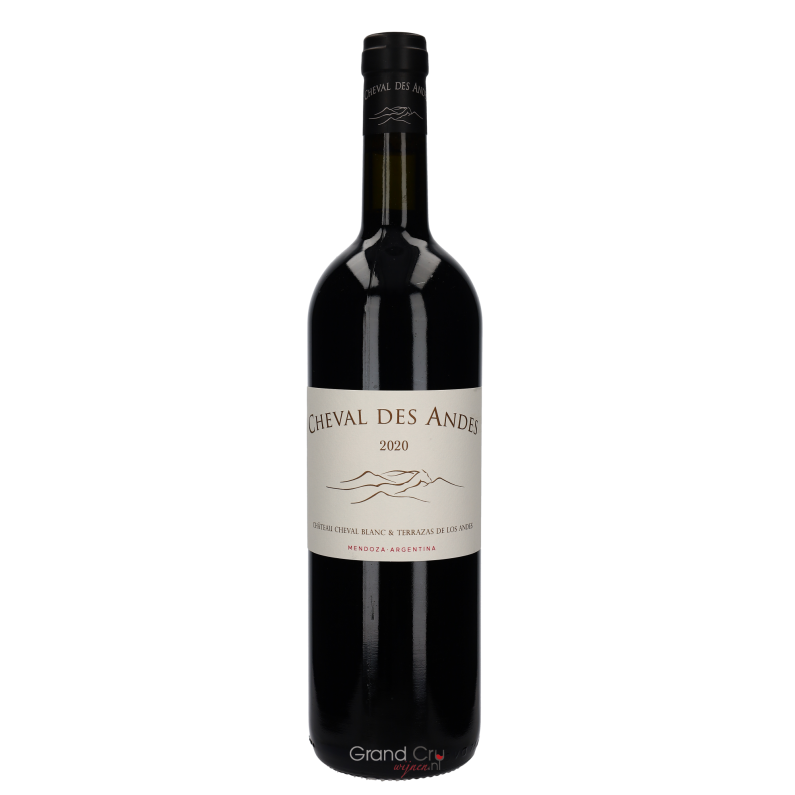
De specificaties zoals vermeld bij de wijn (o.a. wijnjaar) en in de titel zijn leidend en er kunnen geen rechten worden ontleend aan de afbeelding die wordt getoond. Lees meer in onze Frequenty asked questions
| Type of Wine | Red |
|---|---|
| Country | Argentina |
| Region | |
| Winery | |
| Vintage | 2016 |
| Grape | , , , Petit Verdot |
| Content (Alc) | 0.75 ltr (13.5%) |
| Drink window | 2023 - 2036 |
In stock
6 items available
Description
The collaboration between Cheval Blanc from Saint-Emilion and Terrazas from Mendoza has an extra unexpected French touch. The founder and owner of Terrazas is the prestigious Champagne house Moët & Chandon. The style of Cheval des Andes is unique with all elements inspired by Cheval Blanc. The wine of Cheval des Andes combines the lively and intense expression of Argentine Malbec with the rigor, elegance and savoir-faire of a great Bordeaux. The vision of Cheval des Andes is to bring the winemaking philosophy of Château Cheval Blanc - which focuses on wine preservation capabilities and elegance - to Argentina. Cheval des Andes makes wines that age gracefully and "travel through the decades," according to Pierre Lurton, president of Château Cheval Blanc and Cheval des Andes.
The seventeenth vintage of Cheval des Andes, a wine that has undergone a transformation. 2017 is itself a new beginning. A blend of Malbec with 38% Cabernet Sauvignon, with a bold nose of fresh fruit such as sweet and sour cherry with meaty aromas and a hint of white pepper against a bold, woody background. A liquid wine, slightly tight on the palate with a medium structure, a delicate feel and active tannins well integrated into the concise texture, overall nuanced and full-bodied. Features a balance that respects the concentration of the vintage without ever letting it get out of hand. An Argentinian wine made with more than a nod to French expertise.
The 2016 Cheval des Andes comes from a top year with a clear-rimmed ruby red color in the glass. Exotic, highly perfumed aromas of red and blue fruit preserves, candied flowers, incense and Indian spices show excellent definition and mineral lift. Meaty, seductively sweet and expansive on the palate, with deeply concentrated flavors of raspberry, cherry cola, lavender pastilles and fruitcake that show an uncanny delicacy for their strength. Soft, spicy and penetrating with an impressively persistent aftertaste, which is shaped by soft, slowly building, deftly interwoven tannins.
FACT: The wine is in our conditioned Wine Warehouse and if you pick up the wine you will often receive a nice discount . You will see your discount immediately when you choose 'Collect' on the checkout page. We are located in Dordrecht almost next to the A16 with plenty of parking. Click here for our address.
Specifications
| Block Bundle Options | No |
|---|---|
| Type of Wine | Red |
| Country | Argentina |
| Region | Mendoza |
| Icons | Icon South America |
| Winery | Cheval des Andes |
| Grape | Cabernet Franc, Cabernet Sauvignon, Malbec, Petit Verdot |
| Biological certified | No |
| Natural wine | No |
| Vegan | No |
| Vintage | 2016 |
| Drinking as of | 2023 |
| Drinking till | 2036 |
| Alcohol % | 13.5 |
| Alcohol free/low | No |
| Content | 0.75 ltr |
| Oak aging | Yes |
| Sparkling | No |
| Dessert wine | No |
| Closure | Cork |
| Parker rating | 98 |
| Vinous rating | 96 |
| Tasting Profiles | Complex, Dry, Aged on wood, Powerful, Red fruit, Tannines, Full |
| Drink moments | Indruk maken, Open haard |
Professional Reviews
Parker
The Wine Advocate
RP 97+
Reviewed by:
Luis Gutiérrez
Release Price:
$80
Drink Date:
2020 - 2035
I also tasted the 2015 and 2016 next to the newly released 2017 to give it some context and to see the evolution and changes implemented in the last few years. The 2016 Cheval des Andes is probably the freshest wine produced to date and the first vintage when they used 100% own grapes. Of the trio of vintages tasted together—2015, 2016 and 2017—this is the one with less alcohol and more freshness, and it remains a more austere expression, reflecting a cooler and wetter year that resulted in a less exuberant wine, a benchmark for freshness. I'm looking forward to 2018 to see where they go in the next cool vintage after this 2016... They produced 60,000 bottles and 2,400 magnums. It was bottled in December 2017.
There is a big change at Cheval des Andes after the 2011 harvest, and the wines have gradually changed style, going more or less in the direction of a 50/50 blend of Malbec and Cabernet Franc and increasing the amount of grapes from their own vineyards. From 2016 onward, it's 100% grapes from their own vineyards in Luján de Cuyo (Las Compuertas) and in the Valle de Uco (Altamira). I tasted all the wines from 2012 to 2016 to see the evolution at this winery, including: more own grapes; simplification of the blend toward the Malbec/Cabernet idea; great changes in viticulture, especially the irrigation; moving toward organic farming (they have already stopped using herbicides); earlier harvest through a good ripeness early on; less extraction and a soft vinification; and better integration of the oak in the wine by using larger barrels (30% to 40% 400-liter barrels in 2016, with only some 40% new wood, and also large foudres starting in 2017) and trying to select better wood for their barrels.
Since 2012, the team of Cheval Blanc has been more and more involved in the technical management of Cheval des Andes and even more so nowadays with the arrival of Gérald Gabillet, a French viticulturist and winemaker who studied and trained in Bordeaux, as technical manager. He is fully dedicated to the project to translate the vision of Cheval Blanc on each detail from the vineyard management to vinification and aging. They are currently working very deeply in the irrigation management and changed all the younger vineyards (Cabernet Sauvignon and Malbec) from flood irrigation to drip irrigation. The objective is to achieve a better management of water and natural freshness (they have had a specialized consultant on irrigation since 2015) with ripe tannins and ZERO green notes. The aim is to irrigate as little as possible and be able to pick early but getting ripe grapes full of flavor, which is what they think brings the freshness and elegance they want in their wines. The focus in the last few years has been the vineyards to work with more precision, in things that can be seen but also other aspects, like pruning and massal selections and so on. The technical team from Cheval Blanc often travels to Mendoza, for example, to train the staff there on pruning and other things. In the winery, they have been working a lot on the balance between wood and wine in order to preserve the fruit expression. After several years of trials, they are now using a very high amount of bigger volumes (foudres of 400 and 2,500 liters), and they introduced an Austrian cooper to their barrel park.
They only make one red from their 47 hectares of vineyards, 32 of them in Las Compuertas, Vistalba, and 15 in La Consulta, Altamira. They produce 80,000 bottles per vintage. 2017 started with a warm summer, but the freshness of March and April slowed things down, allowing them to achieve the freshness they are looking for. The wines seem to be more transparent to the conditions of the vintage, a result in the changes they have been implementing in the last few years
These notes from Cheval del Andes were published before the wine was offered by the négociants in Bordeaux in early September. I have included them here for context.
Lorem ipsum dolor sit amet, consectetur adipiscing elit. Sed do eiusmod tempor incididunt ut labore et dolore magna aliqua...
Vinous
96
Drinking Window
2026 - 2036
From: The Riches and Richness of Châteauneuf-du-Pape (Dec 2019)
Vivid bright-rimmed ruby. Exotic, highly perfumed aromas of red and blue fruit preserves, candied flowers, incense and Indian spices show outstanding definition and mineral lift. Fleshy, alluringly sweet and expansive in the mouth, offering deeply concentrated raspberry, cherry cola, lavender pastille and fruitcake flavors that show uncanny delicacy for their power. Smooth, spicy and penetrating on the impressively persistent finish, which is given shape by suave, slow-building, deftly interwoven tannins.
- By Josh Raynolds on December 2019
Lorem ipsum dolor sit amet, consectetur adipiscing elit. Sed do eiusmod tempor incididunt ut labore et dolore magna aliqua...
Exclusive Content
Sign in to unlock professional wine reviews from world-renowned critics
Wijnhuis
The collaboration between Cheval Blanc from Saint-Emilion and Terrazas from Mendoza has an extra unexpected French touch. The founder and owner of Terrazas is the prestigious Champagne house Moët & Chandon. The style of Cheval des Andes is unique, with all elements inspired by Cheval Blanc. Cheval des Andes wine combines the lively and intense expression of Argentine Malbec with the rigor, elegance and savoir-faire of a great Bordeaux. It is a unique blend of Malbec grapes and Bordeaux varieties - an ensemble with the exuberance of Malbec balanced by the moderation of Cabernet Sauvignon, complemented by hints of Petit Verdot. The vision of Cheval des Andes is to bring the winemaking philosophy of Château Cheval Blanc - which focuses on wine storage capabilities and elegance - to Argentina. Cheval des Andes makes wines that age gracefully and "travel through the decades," said Pierre Lurton, president of Château Cheval Blanc and Cheval des Andes. The wines are elegant, meaning they give the most refined expression of Mendoza's terroir. On the nose they are complex rather than intense and on the palate they are balanced rather than powerful.

The collaboration between Cheval Blanc from Saint-Emilion and Terrazas from Mendoza has an extra unexpected French touch. The founder and owner of Terrazas is the prestigious Champagne house Moët & Chandon. The style of Cheval des Andes is unique with all elements inspired by Cheval Blanc. The wine of Cheval des Andes combines the lively and intense expression of Argentine Malbec with the rigor, elegance and savoir-faire of a great Bordeaux. The vision of Cheval des Andes is to bring the winemaking philosophy of Château Cheval Blanc - which focuses on wine preservation capabilities and elegance - to Argentina. Cheval des Andes makes wines that age gracefully and "travel through the decades," according to Pierre Lurton, president of Château Cheval Blanc and Cheval des Andes.
The seventeenth vintage of Cheval des Andes, a wine that has undergone a transformation. 2017 is itself a new beginning. A blend of Malbec with 38% Cabernet Sauvignon, with a bold nose of fresh fruit such as sweet and sour cherry with meaty aromas and a hint of white pepper against a bold, woody background. A liquid wine, slightly tight on the palate with a medium structure, a delicate feel and active tannins well integrated into the concise texture, overall nuanced and full-bodied. Features a balance that respects the concentration of the vintage without ever letting it get out of hand. An Argentinian wine made with more than a nod to French expertise.
The 2016 Cheval des Andes comes from a top year with a clear-rimmed ruby red color in the glass. Exotic, highly perfumed aromas of red and blue fruit preserves, candied flowers, incense and Indian spices show excellent definition and mineral lift. Meaty, seductively sweet and expansive on the palate, with deeply concentrated flavors of raspberry, cherry cola, lavender pastilles and fruitcake that show an uncanny delicacy for their strength. Soft, spicy and penetrating with an impressively persistent aftertaste, which is shaped by soft, slowly building, deftly interwoven tannins.
FACT: The wine is in our conditioned Wine Warehouse and if you pick up the wine you will often receive a nice discount . You will see your discount immediately when you choose 'Collect' on the checkout page. We are located in Dordrecht almost next to the A16 with plenty of parking. Click here for our address.
| Block Bundle Options | No |
|---|---|
| Type of Wine | Red |
| Country | Argentina |
| Region | Mendoza |
| Icons | Icon South America |
| Winery | Cheval des Andes |
| Grape | Cabernet Franc, Cabernet Sauvignon, Malbec, Petit Verdot |
| Biological certified | No |
| Natural wine | No |
| Vegan | No |
| Vintage | 2016 |
| Drinking as of | 2023 |
| Drinking till | 2036 |
| Alcohol % | 13.5 |
| Alcohol free/low | No |
| Content | 0.75 ltr |
| Oak aging | Yes |
| Sparkling | No |
| Dessert wine | No |
| Closure | Cork |
| Parker rating | 98 |
| Vinous rating | 96 |
| Tasting Profiles | Complex, Dry, Aged on wood, Powerful, Red fruit, Tannines, Full |
| Drink moments | Indruk maken, Open haard |
Parker
The Wine Advocate
RP 97+
Reviewed by:
Luis Gutiérrez
Release Price:
$80
Drink Date:
2020 - 2035
I also tasted the 2015 and 2016 next to the newly released 2017 to give it some context and to see the evolution and changes implemented in the last few years. The 2016 Cheval des Andes is probably the freshest wine produced to date and the first vintage when they used 100% own grapes. Of the trio of vintages tasted together—2015, 2016 and 2017—this is the one with less alcohol and more freshness, and it remains a more austere expression, reflecting a cooler and wetter year that resulted in a less exuberant wine, a benchmark for freshness. I'm looking forward to 2018 to see where they go in the next cool vintage after this 2016... They produced 60,000 bottles and 2,400 magnums. It was bottled in December 2017.
There is a big change at Cheval des Andes after the 2011 harvest, and the wines have gradually changed style, going more or less in the direction of a 50/50 blend of Malbec and Cabernet Franc and increasing the amount of grapes from their own vineyards. From 2016 onward, it's 100% grapes from their own vineyards in Luján de Cuyo (Las Compuertas) and in the Valle de Uco (Altamira). I tasted all the wines from 2012 to 2016 to see the evolution at this winery, including: more own grapes; simplification of the blend toward the Malbec/Cabernet idea; great changes in viticulture, especially the irrigation; moving toward organic farming (they have already stopped using herbicides); earlier harvest through a good ripeness early on; less extraction and a soft vinification; and better integration of the oak in the wine by using larger barrels (30% to 40% 400-liter barrels in 2016, with only some 40% new wood, and also large foudres starting in 2017) and trying to select better wood for their barrels.
Since 2012, the team of Cheval Blanc has been more and more involved in the technical management of Cheval des Andes and even more so nowadays with the arrival of Gérald Gabillet, a French viticulturist and winemaker who studied and trained in Bordeaux, as technical manager. He is fully dedicated to the project to translate the vision of Cheval Blanc on each detail from the vineyard management to vinification and aging. They are currently working very deeply in the irrigation management and changed all the younger vineyards (Cabernet Sauvignon and Malbec) from flood irrigation to drip irrigation. The objective is to achieve a better management of water and natural freshness (they have had a specialized consultant on irrigation since 2015) with ripe tannins and ZERO green notes. The aim is to irrigate as little as possible and be able to pick early but getting ripe grapes full of flavor, which is what they think brings the freshness and elegance they want in their wines. The focus in the last few years has been the vineyards to work with more precision, in things that can be seen but also other aspects, like pruning and massal selections and so on. The technical team from Cheval Blanc often travels to Mendoza, for example, to train the staff there on pruning and other things. In the winery, they have been working a lot on the balance between wood and wine in order to preserve the fruit expression. After several years of trials, they are now using a very high amount of bigger volumes (foudres of 400 and 2,500 liters), and they introduced an Austrian cooper to their barrel park.
They only make one red from their 47 hectares of vineyards, 32 of them in Las Compuertas, Vistalba, and 15 in La Consulta, Altamira. They produce 80,000 bottles per vintage. 2017 started with a warm summer, but the freshness of March and April slowed things down, allowing them to achieve the freshness they are looking for. The wines seem to be more transparent to the conditions of the vintage, a result in the changes they have been implementing in the last few years
These notes from Cheval del Andes were published before the wine was offered by the négociants in Bordeaux in early September. I have included them here for context.
Lorem ipsum dolor sit amet, consectetur adipiscing elit. Sed do eiusmod tempor incididunt ut labore et dolore magna aliqua...
Vinous
96
Drinking Window
2026 - 2036
From: The Riches and Richness of Châteauneuf-du-Pape (Dec 2019)
Vivid bright-rimmed ruby. Exotic, highly perfumed aromas of red and blue fruit preserves, candied flowers, incense and Indian spices show outstanding definition and mineral lift. Fleshy, alluringly sweet and expansive in the mouth, offering deeply concentrated raspberry, cherry cola, lavender pastille and fruitcake flavors that show uncanny delicacy for their power. Smooth, spicy and penetrating on the impressively persistent finish, which is given shape by suave, slow-building, deftly interwoven tannins.
- By Josh Raynolds on December 2019
Lorem ipsum dolor sit amet, consectetur adipiscing elit. Sed do eiusmod tempor incididunt ut labore et dolore magna aliqua...
Exclusive Content
Sign in to unlock professional wine reviews from world-renowned critics
The collaboration between Cheval Blanc from Saint-Emilion and Terrazas from Mendoza has an extra unexpected French touch. The founder and owner of Terrazas is the prestigious Champagne house Moët & Chandon. The style of Cheval des Andes is unique, with all elements inspired by Cheval Blanc. Cheval des Andes wine combines the lively and intense expression of Argentine Malbec with the rigor, elegance and savoir-faire of a great Bordeaux. It is a unique blend of Malbec grapes and Bordeaux varieties - an ensemble with the exuberance of Malbec balanced by the moderation of Cabernet Sauvignon, complemented by hints of Petit Verdot. The vision of Cheval des Andes is to bring the winemaking philosophy of Château Cheval Blanc - which focuses on wine storage capabilities and elegance - to Argentina. Cheval des Andes makes wines that age gracefully and "travel through the decades," said Pierre Lurton, president of Château Cheval Blanc and Cheval des Andes. The wines are elegant, meaning they give the most refined expression of Mendoza's terroir. On the nose they are complex rather than intense and on the palate they are balanced rather than powerful.
 Follow the latest news about all our wines, promotions, and new selections.